Japan's Other Great Fish Markets: Beyond Tokyo
A guide to Japan's best regional seafood markets outside Tokyo — Kuromon, Nishiki, Hakodate, Karato, Omicho, Aomori and more. Hours, access, specialities and honest advice on which are worth the trip.
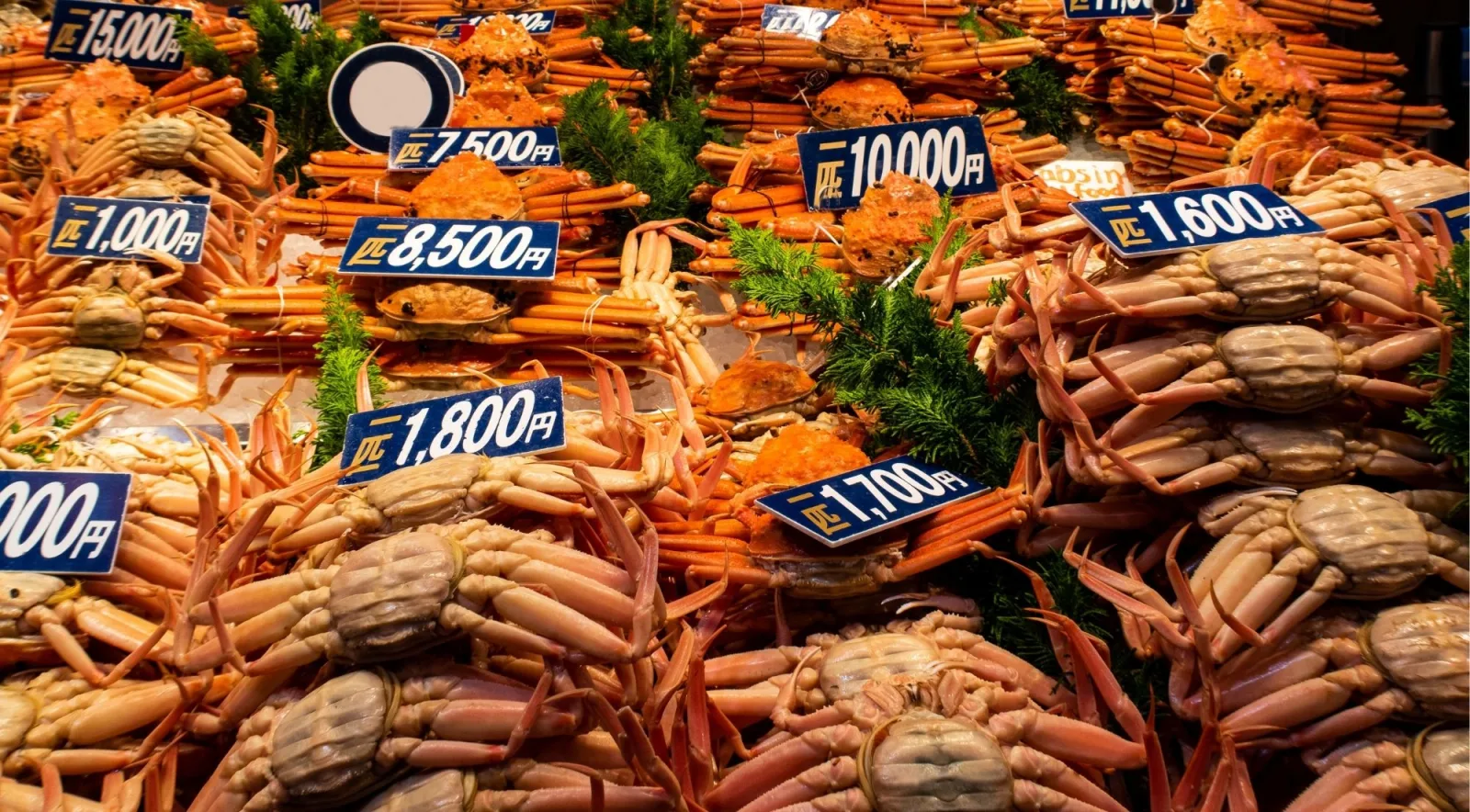
The short answer: Tokyo’s Toyosu and Tsukiji get the headlines, but Japan’s most rewarding seafood markets are spread the length of the archipelago — from Hokkaido squid you catch yourself to Shimonoseki’s silent fugu auction and Kanazawa’s snow crab.
- The single best regional market for most travellers is Kanazawa’s Omicho or Hokkaido’s Hakodate Morning Market — both combine working local commerce with outstanding eat-on-the-spot seafood; Kuromon (Osaka) and Nishiki (Kyoto) are the most convenient on the Golden Route but are now heavily touristed.
- For unique spectacle, go regional: catch and eat your own squid at Hakodate, build a custom rice bowl ticket-by-ticket at Aomori’s Nokkedon, or eat fugu by the Kanmon Strait at Shimonoseki’s Karato Market (the town’s Haedomari fugu auction, however, is closed to the public).
- Verify before you go: hours and closed days vary shop-by-shop, several markets are still recovering from the January 2024 Noto earthquake (Wajima’s 1,000-year-old market is operating only as a roughly 30-stall temporary market), and many stalls are cash-only.
If Tokyo is your focus, start with our companion guides to the Toyosu Market and the Tsukiji Outer Market, or compare the two in Tsukiji vs Toyosu. This article is about everywhere else — and because Tokyo is the one market city where the logistics can be handed to a guide, that is where the bookable option sits:
The Key Facts, Verified
- Japan’s markets fall into three types — central wholesale markets (like Toyosu), local/regional wholesale markets (Karato, Shiogama), and retail morning markets or asaichi (Hakodate, Wajima, Yobuko). Whether you can watch an auction depends almost entirely on which type you visit.
- Overtourism is now a real editorial theme. In 2015 Kuromon Ichiba was visited by an average of 23,000 people a day (a figure that has almost certainly risen since — jrpass.com cites about 25,000 a day in 2018), and locals increasingly describe it as a tourist food court; Kyoto’s Nishiki Market — which drew roughly 30% of all foreign tourists visiting Kyoto in 2017 — has, since October 2018, asked its stores to display multilingual “No eating while walking” signs.
- Post-disaster status matters. Wajima’s morning market was destroyed by fire after the January 2024 Noto earthquake and now runs as a small temporary market; Kanazawa’s Omicho, further south, was largely unaffected and is operating normally.
- The “build your own bowl” experience is a regional highlight — Aomori’s Nokkedon ticket system and Shiogama’s “My Kaisendon” corner both let you assemble a custom seafood rice bowl, and Naha’s Makishi market lets you buy fish downstairs and have it cooked upstairs.
How Japanese Fish Markets Work
Understanding the system tells you what to expect — and whether you’ll get to see an auction.
Central wholesale markets (中央卸売市場, chūō oroshiuri shijō). These are the big municipal markets that supply a whole metropolis, established under Japan’s wholesale market law with the goal of roughly one central market per major city. Toyosu in Tokyo and the Osaka Municipal Central Wholesale Market are examples. They run professional dawn auctions (tuna, etc.), and visitor access is controlled — you typically watch from designated observation decks or via the lottery/registration systems.
Local and regional wholesale markets (地方卸売市場, chihō oroshiuri shijō). Smaller markets serving a city or region. Some are privately operated. Crucially, several of these — Karato in Shimonoseki, Shiogama in Miyagi — are unusually open to the general public, letting ordinary shoppers and tourists buy directly and, in some cases, watch the trading floor.
Retail morning markets (朝市, asaichi). These are the street-stall markets that open before dawn and wind down by early afternoon: Hakodate, Wajima, Yobuko, Takayama. They are retail-facing by design — no restricted auction, just vendors selling directly to you. Japan’s “three great morning markets” are traditionally cited as Wajima (Ishikawa), Takayama (Gifu), and either Katsuura (Chiba) or Yobuko (Saga), depending on the source.
The practical upshot: if watching a live auction is your goal, target a market that explicitly offers auction viewing (Toyosu, Shiogama, Numazu, Sakaiminato). If you want to eat, shop and soak up atmosphere, the retail morning markets and public-facing local markets are far more rewarding.
Other Experiences You Might Enjoy
Before the regional profiles, the one market on this list where a guided morning is genuinely bookable: Toyosu Market in Tokyo, whose pre-dawn tuna auction is the benchmark every market below gets measured against, and the Tsukiji Outer Market twenty minutes away, where the same fish turns into tamagoyaki, grilled scallops and a Sushi Dai breakfast. If Tokyo is on your route, this is the market morning to book rather than improvise:
Kuromon Ichiba (黒門市場), Osaka — “Osaka’s Kitchen”
Location: Nipponbashi, Chuo Ward, Osaka. Type: Retail market arcade.
Kuromon Ichiba traces its origins to around 1822–1823, when fresh-fish merchants gathered near the black-lacquered gate of Enmyōji Temple — the “black gate” (黒門, kuromon) giving the market its name. The temple and its gate were lost in a 1912 fire, but the market was officially designated a permanent market by Osaka in 1902 and rebuilt after wartime bombing. Today the covered arcade runs roughly 580 metres and holds around 150 shops (some sources say up to 170), selling fresh fish, wagyu, fruit, pickles and prepared street food.
What to eat: grilled scallops, otoro tuna sushi, wagyu skewers, fresh sea urchin, tempura, fugu in winter and hamo (pike conger) in summer — at least 10% of the seafood shops historically specialised in fugu and hamo.
The overtourism debate. This is the honest core of Kuromon’s story. In 2015 the market was visited by an average of 23,000 people a day (and, per jrpass.com, around 25,000 a day by 2018), and its character has shifted markedly. What was once primarily a wholesaler’s and local shopping street has become one of Japan’s most photographed street-food destinations; many stalls that sold bulk to restaurants now sell individual portions to tourists, packaging is more elaborate, and prices have risen. Reviewers increasingly call it a “tourist trap.” The fairer verdict: Kuromon is now a hybrid — heavily marketed and tourist-priced, but still supplied by Osaka’s wholesale markets and still used by locals, which keeps quality honest. Go for convenience and spectacle, not for local-market value.
Auctions viewable? No — Kuromon is a retail arcade, not an auction market.
Hours & closed days: Varies by shop; broadly 8:00/9:00–18:00. The information centre runs about 9:00–18:00. Closed January 1–4; roughly 10–15% of vendors (mostly small family shops) close on Sundays.
Access: One minute from Nippombashi Station (Sakaisuji/Sennichimae lines, Exit 10); about 10 minutes’ walk from Namba.
Worth a detour? Not a special trip, but an easy and fun add-on if you’re already in Namba/Dotonbori. Go at 8:30–9:00am to beat the crowds.
Nishiki Market (錦市場), Kyoto — “Kyoto’s Kitchen”
Location: Nishikikoji Street, central Kyoto. Type: Retail market arcade.
Nishiki has fed Kyoto for around 400 years; records suggest a market here as early as the Heian period, and it thrived in the Edo period as a fish-wholesaling district authorised by the shogunate (around 1615). The narrow covered arcade runs about 390–400 metres from Teramachi to Takakura and holds roughly 130 shops (some sources cite around 126). Under a colourful stained-glass canopy, specialists sell Kyoto’s signature ingredients: tsukemono (pickles), yuba (tofu skin), fresh tofu, hamo, dashimaki tamago, guji (tilefish), and kyo-yasai (Kyoto vegetables). Look for Aritsugu, the celebrated knife maker with centuries of history.
The walking-while-eating rule. Nishiki is the strictest market in Japan about tabe-aruki (eating while walking). As visitor numbers surged — the market drew roughly 30% of all foreign tourists visiting Kyoto in 2017 — the Nishiki Market Shopping District Promotion Association has, since October 2018, asked its stores to display “No eating while walking” signs in Japanese, English, Chinese and Korean, and to have customers eat instead at the stall where they bought their food or in a designated eat-in space. The association’s own wording is a request (“Please refrain from walking in the market while eating… Please eat the food in front of or inside the shop where you bought it”) rather than a legally enforced ban with a fine — but it is taken seriously and signposted throughout the arcade.
Auctions viewable? No.
Hours & closed days: Most shops open around 9:00–17:00/18:00; closed days vary by shop, commonly Wednesday or Sunday.
Access: A few minutes’ walk from Shijo Station (Karasuma line) or Kawaramachi Station (Hankyu line).
Worth a detour? Yes if you’re in Kyoto — it pairs naturally with Pontocho and Gion. It is more a culinary-culture stroll than a raw-seafood market.
Hakodate Morning Market (函館朝市), Hokkaido
Location: Beside JR Hakodate Station. Type: Retail morning market (asaichi).
Hakodate’s Asaichi is Hokkaido’s most famous morning market — a roughly 33,000-square-metre sprawl of about 250 shops divided into zones including the Hakodate Asaichi Hiroba, the indoor Ekini Market, and a producers’ direct-sales area. Hakodate faces the sea on three sides, and seafood dominates.
The signature experience — catch your own squid. At the Ganso Katsu Ika Tsuribori (live squid-fishing pool) inside the Ekini Market, you fish a live squid from a tank with a rod and staff prepare it as sashimi on the spot — translucent, still twitching, firm and sweet. Squid species rotate: spear squid (yari-ika) roughly January–May; common/Pacific flying squid (ma-ika) roughly June–December.
Also eat: kaisendon (seafood rice bowls) in “Donburi Yokocho” (Rice Bowl Alley), uni, crab, scallops, salmon roe, and Hakodate shio ramen.
Auctions viewable? No public auction; this is a retail market.
Hours & closed days: Roughly 5:00am (6:00am January–April) to around 14:00; individual shops vary. The squid-fishing corner runs about 6:30am–13:30 or until squid sell out, and closes on the third Wednesday of many months and over New Year, plus days when fishing is cancelled for weather. Arrive before 8:30am to beat cruise-ship crowds.
Access: 1–5 minutes’ walk from JR Hakodate Station.
Worth a detour? Yes — the squid experience is genuinely unique, and Hakodate is a worthwhile destination in its own right. Reviewers note prices can feel touristy but freshness is excellent, often better value than Sapporo or Tokyo.
Nijo Market (二条市場), Sapporo, Hokkaido
Location: Chuo Ward, central Sapporo, by the Soseigawa River. Type: Retail public market.
Nijo Market has operated for over 100 years and occupies about one city block in downtown Sapporo. It’s a compact, retro, Showa-era-feeling market of around 20 fresh-fish shops plus restaurants, where locals and tourists shop for crab, salmon roe, sea urchin, scallops and hokke. A narrow alley called Noren Yokocho holds small restaurants and bars.
What to eat: kaisendon is the star — many shops serve generous Hokkaido bowls of uni, ikura, crab and scallop. A fresh-seafood breakfast here is the classic move.
Auctions viewable? No auction at Nijo itself. Sapporo’s separate Central Wholesale Market and adjacent Curb Market (Jogai Ichiba) offer early-morning auction tours (roughly 5:15–7:30am) that must be booked in advance.
Hours & closed days: Roughly 7:00–18:00 daily; individual shops keep their own hours and closed days.
Access: Central Sapporo, a short walk from Odori and the Susukino area.
Worth a detour? Convenient rather than essential — great for a seafood breakfast if you’re in Sapporo, but smaller and more tourist-facing than Hakodate’s market.
Karato Market (唐戸市場), Shimonoseki, Yamaguchi — the Fugu Capital
Location: On the Kanmon Strait, Shimonoseki. Type: Regional (local) wholesale market, unusually open to the public.
Shimonoseki is Japan’s fugu (pufferfish) capital, and Karato Market is its user-friendly public face. Founded as an open-air waterfront fish market in 1909, Karato is a regional wholesale market where local fishermen sell directly — and rare among such markets, the general public can buy too. It sits right on the Kanmon Strait separating Honshu from Kyushu, a rich crossroads for fish from the Sea of Japan and the Inland Sea. Locally, fugu is called “fuku,” a lucky pun meaning good fortune.
The Iki-iki Bakangai event. On Fridays, Saturdays, Sundays and public holidays, the market’s ground floor turns into a bustling street-food bazaar — dozens of stalls selling fresh nigiri sushi, kaisendon, fugu soup (fuku-jiru), fugu sashimi (fuku-sashi) and fried seafood. This is the reason most visitors come; a weekday visit is atmospheric but far quieter.
Auctions. Karato’s own trading floor is, per Yamaguchi’s official tourism site, open to public viewing (early-morning weekday trading). However, the famous fugu auction happens elsewhere and is not open to the public — see Haedomari below.
Hours & closed days: Market roughly 5:00am–15:00 Monday–Saturday, from 8:00am Sundays and holidays, open 365 days a year. Iki-iki Bakangai: Friday & Saturday 10:00–15:00; Sunday & holidays 8:00–15:00 (until sold out). Bring cash — most stalls are cash-only.
Access: About 15 minutes by Sanden Kotsu bus from JR Shimonoseki Station to the Karato stop, then a short walk. Next to the Kaikyokan Aquarium and Kamon Wharf.
Worth a detour? Yes — one of the best market experiences in western Japan, especially on a weekend, and fugu here is a bucket-list dish.
Haedomari Market (南風泊市場) and the silent fugu auction
Eight kilometres west of Karato, Haedomari is Japan’s only wholesale market dedicated to fugu — handling over 1,500 tonnes a year, including the much sought-after wild torafugu variety. (Shimonoseki is said to handle roughly 80% of Japan’s nationally distributed wild torafugu.) Its auction, beginning in the small hours (around 3:00–3:30am), uses the extraordinary “bag auction” (fukuro-seri): the auctioneer hides his hand inside a black cloth bag and buyers bid secretly by gripping his fingers in coded ways, with different grips representing different price units. It is said to be the only market still using this method. Crucially, Haedomari is a traders-only market and is closed to the general public — multiple Shimonoseki city tourism sources state plainly that public viewing is not possible. Tourists should go to Karato instead.
Omicho Market (近江町市場), Kanazawa, Ishikawa
Location: Central Kanazawa. Type: Retail public market.
“Kanazawa’s Kitchen” has operated since 1721 — nearly 300 years — and is a covered network of streets holding roughly 170–185 shops (renovated in 2009). Kanazawa’s position on the Sea of Japan gives it some of the country’s richest fishing grounds, and Omicho is the place to taste them.
What to eat: In winter (November–March), snow crab is the prize — including kobako-gani (female snow crab, prized for roe) and larger male matsuba-gani. Year-round highlights include buri (yellowtail), gasu-ebi (a local sweet shrimp), amaebi (sweet shrimp), nodoguro (blackthroat seaperch), oysters, scallops and squid. Kaisendon is the signature dish, and many stalls prepare sashimi to eat on the spot.
The 2024 Noto earthquake. Kanazawa sits well south of the quake’s epicentre on the Noto Peninsula and Omicho was largely unaffected; it operates normally. (This is in sharp contrast to Wajima, further north — see below.)
Auctions viewable? No public auction; retail market.
Hours & closed days: Broadly 9:00–17:00 (a useful planning window is 9:00–16:00); many shops close Wednesdays, and most close over the New Year holiday. Go in the morning — popular items sell out before noon.
Access: 15–20 minutes’ walk from JR Kanazawa Station, or a short bus ride to the Musashigatsuji / Omicho Market stop.
Worth a detour? Strongly yes, especially in crab season. It manages to be both a genuine working local market and very welcoming to visitors — arguably the best all-round regional market on this list.
Furukawa Market / Aomori Gyosai Center (青森魚菜センター), Aomori — the Nokkedon
Location: Central Aomori, 5 minutes from JR Aomori Station. Type: Retail public market.
Known locally as Furukawa Market, the Aomori Gyosai Center is home to the original “Nokkedon” — a build-your-own seafood rice bowl system that is one of the most fun food experiences in Tohoku.
How the ticket system works. At the Nokkedon information office you buy a booklet of meal tickets. You then collect a bowl of rice and walk the market’s roughly 30 shops, handing over tickets in exchange for whichever toppings you want — Mutsu Bay scallops, tuna, other sashimi, plus deli items, meat and miso soup — building your own custom bowl (the “ultimate selfish donburi,” as the market cheerfully puts it). Prices were revised on 1 May 2025 (a 12-ticket booklet and single tickets are available; exact counts posted at the office).
Auctions viewable? No; retail market.
Hours & closed days: Morning through early afternoon; check the market’s calendar for closed days (typically Tuesdays). Rice can sell out at busy times.
Access: About 5 minutes’ walk from JR Aomori Station.
Worth a detour? Yes if you’re in Aomori or travelling the Tohoku Shinkansen — the interactive bowl-building is memorable and great for families.
Yanagibashi Rengo Market (柳橋連合市場), Fukuoka — “Hakata’s Kitchen”
Location: Chuo Ward, Fukuoka. Type: Retail market arcade.
Established in 1916, Yanagibashi Rengo Ichiba is Fukuoka’s “Hakata’s Kitchen” — a compact covered arcade of around 50 shops (some counts cite about 47) frequented by professional chefs and home cooks. It’s fed by the rich Genkai Sea and Sea of Japan fishing grounds around Tsushima, Iki and the Goto Islands.
What to eat & buy: sashimi-grade fish sliced to order, fried kamaboko fish cakes, tempura, and Fukuoka’s signature karashi mentaiko (spicy cod roe). Some shops offer eat-in options. A quick walkthrough takes 20–30 minutes.
Auctions viewable? No.
Hours & closed days: Roughly 8:00–18:00 (varies by shop); closed Sundays and national holidays.
Access: About 15 minutes’ walk from JR Hakata Station; nearest station Yakuin (Nishitetsu line); Yanagibashi bus stop adjacent.
Other Fukuoka options: the nearby narrow Sankaku Market (good for udon) is often paired with Yanagibashi on food tours. Note that Fukuoka’s main central wholesale fish market (Nagahama) is a professional facility with limited public access.
Worth a detour? A pleasant, authentic local stop rather than a headline attraction — best combined with a Hakata food tour and the city’s famous yatai (night food stalls).
Other Significant Markets
Wajima Morning Market (輪島朝市), Ishikawa — handle with care
Wajima’s asaichi, on the northern tip of the Noto Peninsula, is one of Japan’s “three great morning markets,” with roots going back over 1,000 years to festival-day bartering. It was devastated on 1 January 2024, when the magnitude-7 Noto Peninsula earthquake triggered a fire that destroyed the historic Asaichi-dori market street; further flooding struck in September 2024. As of late 2025, the original site remains cleared land. Per the Japanese government’s HIGHLIGHTING Japan (November 2025), the market “now has a temporary home at the Wai Plaza with approximately 30 shops,” run largely by its women vendors. Reconstruction plans envisage a covered plaza of about 2,500 square metres, but a market official (Hashimoto) states it is “expected to be at least three years before tourists can visit the new market site.” Visit to support the community, but set expectations accordingly and check current status before travelling.
Yobuko Morning Market (呼子朝市), Saga — live squid
In the port town of Yobuko (Karatsu City), this is another of Japan’s celebrated morning markets, running since the Taisho era. About 40–50 stalls line a roughly 200-metre street, open daily except New Year’s Day, 7:30am–12:00. Yobuko is synonymous with ultra-fresh “living” squid (ika) served transparent and still moving, plus dried squid, sea urchin opened on the spot, and Saga beef croquettes. Access is about 40 minutes by bus from Karatsu.
Katsuura, Wakayama — tuna auctions
Nachi-Katsuura in Wakayama is renowned for large tuna catches using sustainable pole-and-line-era techniques dating to the mid-1800s. The Katsuura port market (Katsuura Gyoko Nigiwai Ichiba) has restaurants serving tuna sashimi, sushi and cutlets, and tuna-auction viewing tours with a sashimi breakfast are available. (Note: “Katsuura” morning market is sometimes cited among the three great morning markets — that reference is to Katsuura in Chiba, a different place.)
Shiogama and Kesennuma, Miyagi — Sanriku coast
Shiogama Seafood Wholesale Market (塩釜水産物仲卸市場) is a public-access wholesale market of around 140 stalls beside one of Japan’s biggest fresh-tuna ports, with over 20 tuna specialists. Its signature is the “My Kaisendon” corner: buy a rice-and-miso-soup set, then add your choice of sashimi from the stalls to build your own bowl; there’s also a grill-it-yourself corner. Eating while walking is prohibited — use the eat-in corner. Visitors can watch the tuna auction from a second-floor observation deck or via a guided tour. Closed Wednesdays, Obon and January 1–4. About 15 minutes’ walk from Higashi-Shiogama Station.
Kesennuma Fish Market (気仙沼市魚市場) is one of Japan’s great fishing ports — Japan’s top producer of bonito (katsuo), and, per VISIT MIYAGI, it “accounts for more than 70% of the country’s shark and swordfish production.” Visitors can watch boats unload and observe silent auctions; English guided tours are available by advance booking through the Kesennuma Tourism and Convention Bureau.
Choshi, Chiba — tuna and sardines
Choshi, at the mouth of the Tone River, has three wholesale fish markets and is one of the Kanto region’s most important fishing ports, landing tuna, sardines and marlin. Visitors go primarily to eat — the Wosse 21 seafood market and the Choshi Fishing Port’s Maiwai Shokudo cafeteria serve the day’s catch — and to watch early-morning auction activity. Easily combined with the Inubozaki Lighthouse and Choshi Electric Railway.
Sakaiminato, Tottori — crab
Sakaiminato is one of Japan’s leading fishing ports, landing the country’s largest catches of red snow crab (beni-zuwai-gani) and Pacific bluefin tuna — reportedly producing around 60% of Japan’s red snow crabs. The Sakaiminato seafood direct-sales centres (including Tairyo Ichiba Nakaura, marked by a 7.7m Kitaro statue) sell crab, tuna and squid, with dining on-site. Auction viewing is possible from a glassed observation area or the second-floor balcony. Seasonal highlights: red snow crab (Sept–June), matsuba (snow) crab (Nov–Feb), raw bluefin (June–July). The town is also the birthplace of manga artist Shigeru Mizuki, so Gegege no Kitaro attractions abound.
Numazu Fish Market (沼津魚市場 / INO), Shizuoka — Mt Fuji views
Numazu Port on Suruga Bay houses a marine complex (INO) with a wholesale fish market, restaurants, and an observation deck with Mt Fuji views. Visitors can watch the morning auction (roughly 5:45–7:00am) from an observation passageway above the floor, then eat conveyor-belt sushi or a seafood bowl. Suruga Bay is famed for deep-water species and Numazu’s aji (horse mackerel). An easy day trip from Tokyo or a stop en route to Izu.
Miyako and the Sanriku coast, Iwate
The Miyako Fish Market (宮古市魚菜市場) is a compact public market about 10 minutes north of Miyako Station selling salmon, crab, abalone, uni and seaweed from the rich Sanriku coast, plus a section where local farm families sell produce directly. Its inland location spared it direct damage in the 2011 tsunami. A good, unpretentious stop for travellers exploring the Sanriku Coast.
Naha City First Makishi Public Market (第一牧志公設市場), Okinawa
Naha’s Makishi market, just off Kokusai-dori, is “Okinawa’s Kitchen.” Established in 1950 from a post-war market, it was rebuilt due to ageing and reopened at its original site in March 2023. The ground floor is a wet market of vivid Okinawan reef fish (in colours that look startling to mainland eyes), pork, sea grapes and local produce; the upper floor has around a dozen restaurants. Its signature is the “mochiage” (lift-up) system, in place since around 1990: buy your seafood downstairs, take it upstairs, and have a restaurant cook it for a small preparation fee. Distinctly Okinawan and very fun; the market is a working local institution as well as a tourist hub.
Famous morning markets (asaichi) worth noting
Beyond Wajima and Yobuko, Takayama’s twin morning markets (Miyagawa and Jinya-mae) in Gifu are among the “three great morning markets,” though they lean toward produce, pickles and crafts rather than seafood — about 40–50 stalls each, a 10-minute walk from Takayama Station, open roughly 6:00/7:00am–noon. Sendai’s small Asaichi and Osaka’s Kizu Wholesale Market (a rare privately run wholesale market with a twice-monthly public “Kizu Asaichi”) are also worth knowing.
Master Comparison Table
| Market | City / Prefecture | Known for | Best time to visit | Auctions viewable? |
|---|---|---|---|---|
| Kuromon Ichiba (黒門市場) | Osaka | Street food, wagyu, fugu, hamo | 8:30–9:00am weekday | No |
| Nishiki Market (錦市場) | Kyoto | Pickles, yuba, tofu, Kyoto veg | Morning; avoid Wed | No |
| Hakodate Morning Market (函館朝市) | Hakodate, Hokkaido | Catch-your-own squid, kaisendon, uni | 6:00–8:00am | No |
| Nijo Market (二条市場) | Sapporo, Hokkaido | Kaisendon, crab, uni | Morning | No (tours at nearby Central/Curb market) |
| Karato Market (唐戸市場) | Shimonoseki, Yamaguchi | Fugu, Iki-iki Bakangai sushi | Fri–Sun & holidays, morning | Yes (public); Haedomari fugu auction NOT public |
| Omicho Market (近江町市場) | Kanazawa, Ishikawa | Snow crab, buri, sweet shrimp | Morning, winter for crab | No |
| Aomori Nokkedon (青森魚菜センター) | Aomori | Build-your-own bowl (ticket system) | Morning | No |
| Yanagibashi Rengo (柳橋連合市場) | Fukuoka | Mentaiko, fish cakes, sashimi | Morning; closed Sun/hols | No |
| Wajima Asaichi (輪島朝市) | Wajima, Ishikawa | Historic morning market (temporary site) | Check status first | No |
| Yobuko Asaichi (呼子朝市) | Karatsu, Saga | Live squid | 7:30am–noon | No |
| Katsuura (勝浦) | Nachi-Katsuura, Wakayama | Tuna | Early morning tour | Yes (tour) |
| Shiogama (塩釜水産物仲卸市場) | Shiogama, Miyagi | Tuna, My Kaisendon | Morning; closed Wed | Yes (deck/tour) |
| Kesennuma (気仙沼市魚市場) | Kesennuma, Miyagi | Bonito, shark, swordfish | Early morning tour | Yes (tour) |
| Choshi | Choshi, Chiba | Tuna, sardines | Early morning | Some |
| Sakaiminato | Sakaiminato, Tottori | Red snow crab, bluefin | Nov–Feb crab season | Yes (observation) |
| Numazu (INO) | Numazu, Shizuoka | Aji, deep-sea fish, Fuji views | 5:45–7:00am | Yes (observation) |
| Miyako (宮古市魚菜市場) | Miyako, Iwate | Salmon, uni, Sanriku seafood | Morning | No |
| Makishi (第一牧志公設市場) | Naha, Okinawa | Reef fish, buy-and-cook system | Late morning/lunch | No |
Which Market Suits Which Traveller
- You want auctions and spectacle: Toyosu (Tokyo — see our tuna auction viewing guide), Shiogama and Kesennuma (Miyagi), Sakaiminato (Tottori), Numazu (Shizuoka), or a Katsuura tuna tour. Avoid the retail arcades (Kuromon, Nishiki) if auctions are the point.
- You want street food and grazing: Kuromon (Osaka) and Karato’s Iki-iki Bakangai (Shimonoseki) are the best for eating your way through; Nishiki (Kyoto) too, but eat at the stalls, not while walking. Tokyo’s equivalent is covered stall by stall in our Tsukiji Outer Market street food guide.
- You want to cook, customise or buy: Aomori’s Nokkedon and Shiogama’s My Kaisendon (build your own bowl); Naha’s Makishi (buy downstairs, cook upstairs).
- You want crab: Kanazawa’s Omicho (kobako-gani, matsuba-gani) and Sakaiminato (red snow crab), both at their best November–February.
- You want fugu: Shimonoseki — eat at Karato Market; the Haedomari auction itself is closed to the public.
- You’re on the Golden Route (Tokyo–Kyoto–Osaka): Kuromon and Nishiki are the obvious, convenient choices; add Toyosu/Tsukiji in Tokyo.
- You want off the beaten path: Aomori, Miyako and the Sanriku coast, Yobuko, and Hakodate deliver the most authentic, least tourist-shaped experiences.
Practical Tips for Visiting Any Japanese Fish Market
- Go early. Morning markets peak at dawn and wind down by early-to-mid afternoon; the best fish sells out first and cruise-ship/tour crowds build after 8:30am.
- Carry cash. Many stalls are cash-only, especially at Karato and smaller markets. Convenience-store ATMs near stations accept international cards.
- Mind the walking-while-eating question. It’s discouraged across Japan and specifically requested against at Nishiki, Shiogama and others. Eat at the stall or in a designated eat-in area, and never leave litter.
- Ask before photographing people, and stay out of the way at working markets — vendors are trading, not performing.
- Learn a few key words to identify what you’re seeing: maguro (tuna), uni (sea urchin), ikura (salmon roe), hotate (scallop), kani (crab), ebi (shrimp/prawn), ika (squid), tako (octopus), buri (yellowtail), fugu/fuku (pufferfish), hamo (pike conger), nodoguro (blackthroat seaperch). For tuna cuts and grading, see our tuna cuts guide and our seafood at Toyosu guide.
- Check hours and closed days the day before. Most markets close some combination of Wednesday, Sunday and the New Year period, and individual stalls vary.
Booking a Guided Market Morning
Be clear about what is and isn’t bookable. The regional markets on this list are, almost without exception, places you simply turn up to — free to enter, no ticket, no guide required, and the ones with auction viewing (Shiogama, Kesennuma, Katsuura, Sapporo’s Curb Market) arrange it through their own local tourism bureaus rather than through international booking platforms. Budget an early alarm and a phrasebook, not a reservation.
Tokyo is the exception, and it is the market morning most worth handing to a guide: the auction runs in rapid Japanese before dawn, the transport barely works at that hour, and the Toyosu-then-Tsukiji sequence is easy to get wrong on your own. We book two: Toyosu Tuna Auction & Tsukiji Market Gourmet Adventure (4.90 stars, 415 reviews, from $115), which covers the auction and a tasting walk through the outer market, and Toyosu Tuna Auction + Breakfast at Sushi Dai or Bentomi (4.63 stars, 153 reviews, from $114) if a seat at a landmark sushi counter matters more than the grazing. Compare every format in our best Tokyo fish market tours compared.
Frequently Asked Questions
Which is Japan’s best fish market outside Tokyo? For all-round quality and atmosphere, Kanazawa’s Omicho and Hakodate’s Morning Market are the top picks. For sheer street-food fun, Osaka’s Kuromon and Shimonoseki’s Karato (on weekends) stand out.
Can tourists watch a tuna auction outside Tokyo? Yes — Shiogama (Miyagi) offers observation-deck and guided-tour viewing, Sakaiminato (Tottori) and Numazu (Shizuoka) have observation areas, and Katsuura (Wakayama) and Kesennuma (Miyagi) run auction tours. The retail arcades (Kuromon, Nishiki, Omicho) have no auctions. For record tuna prices, see our bluefin tuna auction record prices explained.
Is Kuromon Market a tourist trap? It’s a hybrid. It’s convenient, lively and still supplied by Osaka’s wholesale markets, but it’s heavily touristed, prices are higher than a local market, and the old wholesale character has faded. Worth it for convenience and spectacle, not for value.
Why can’t you eat while walking at Nishiki Market? The narrow arcade gets extremely crowded, and eating on the move causes congestion, spills and litter. The merchants’ association asks visitors to eat at the stall or in an eat-in space instead. It’s a strong request rather than a fined ban.
Is Wajima Morning Market open after the 2024 earthquake? Only as a temporary market. The historic Asaichi-dori site was destroyed by fire after the January 2024 Noto earthquake; a temporary market of around 30 shops runs at Wai Plaza. A rebuilt market on the original site is expected to take at least three years. Check the latest status before travelling.
Where can I eat fugu safely? Shimonoseki is the fugu capital — eat at Karato Market’s stalls and restaurants, or at licensed fugu specialists. Only licensed chefs may prepare fugu, so stick to established venues.
What’s the “build your own bowl” market? Aomori’s Nokkedon (buy tickets, add toppings shop by shop) and Shiogama’s My Kaisendon (buy a rice set, add sashimi from the stalls) both let you assemble a custom kaisendon. Naha’s Makishi lets you buy seafood downstairs and have it cooked upstairs.
Do I need cash at Japanese fish markets? Yes — assume cash, especially at smaller stalls and at Karato. Larger shops increasingly take cards and IC cards, but don’t rely on it.
How to Plan Around This
- If you’re on the standard Tokyo–Kyoto–Osaka route: do Toyosu/Tsukiji in Tokyo, then pick one of Nishiki (Kyoto) or Kuromon (Osaka) — you don’t need both, and both are convenient add-ons rather than destinations. Go at opening time.
- If you want the single most rewarding regional market trip: go to Kanazawa’s Omicho in crab season (November–February), or Hakodate for the catch-your-own-squid experience. Both justify the journey.
- If auctions are your priority: build the trip around Shiogama, Sakaiminato or Numazu, which offer genuine public auction viewing, rather than the retail arcades.
- If you want fugu or a distinctive event: target Shimonoseki’s Karato on a Friday–Sunday for Iki-iki Bakangai.
- Always verify operating status 24–48 hours ahead via the official market website, and carry cash. For Noto-area markets (Wajima especially), confirm current status before committing.
What would change this advice: if Wajima’s permanent market reopens on its original site (expected 3+ years out), it moves back onto the must-visit list; if Kuromon’s crowding or pricing eases (or worsens) materially, adjust its “convenience-only” rating accordingly; and always re-check seasonal crab and squid windows, which shift year to year.
Notes on the Figures and Sources
- Hours and closed days vary shop-by-shop and change seasonally; the figures here are typical, not guaranteed. Always check the official site before travelling.
- Post-disaster status is fluid. Wajima is operating only as a temporary market; verify current arrangements. Omicho (Kanazawa) was largely unaffected by the 2024 quake.
- Prices are deliberately omitted and change constantly; treat all “value” comments as qualitative.
- Kuromon shop count and length: sources vary between roughly 150 and 170 shops; length is consistently about 580 m, though one source gives a 300–580 m range. The founding date is consistently cited as 1822–1823, with official designation in 1902. The 23,000/day visitor figure is specifically 2015 (per osakastation.com); jrpass.com cites about 25,000/day in 2018 — both pre-date recent tourism surges, so current numbers are likely higher.
- Nishiki shop count ranges from about 126 to 130+; length 390–400 m; “400 years” is the standard claim.
- Nishiki’s tabe-aruki rule is an official request, not a fined legal ban, per the Nishiki Market Shopping District Promotion Association. The multilingual signage campaign dates to October 2018 (per The Japan Times); the “roughly 30% of Kyoto’s foreign tourists” figure is for 2017.
- Karato auction viewing: Yamaguchi’s official tourism site states “the auction scene is open to the public,” but most coverage emphasises the retail floor and Iki-iki Bakangai; the live wholesale auction runs early on weekdays and viewing may be informal. Haedomari’s closure to the public is strongly confirmed by multiple official Shimonoseki sources plus MICHELIN.
- Haedomari volumes: “over 1,500 tonnes of fugu every year” per SilverKris; a secondary source states the market was established in 1974 and that Shimonoseki handles roughly 80% of Japan’s nationally distributed wild torafugu — treat the 80% figure as approximate.
- Wajima temporary market: roughly 30 shops at Wai Plaza and “at least three years” to rebuild, per the Japanese government’s HIGHLIGHTING Japan (November 2025). The original market had 150–200+ shops.
- Aomori Nokkedon pricing rose on 1 May 2025 per the official site; exact ticket prices are deliberately omitted here because they change.
- Kesennuma: “more than 70% of the country’s shark and swordfish production” per VISIT MIYAGI (official); visit-kesennuma.com adds that it has ranked first in Japan for fresh bonito landings for 26 consecutive years.
- Sakaiminato’s “roughly 60% of Japan’s red snow crab” comes from an airline/tourism promotional source and should be treated as approximate.
- “Three great morning markets”: sources disagree on the third member — some cite Katsuura (Chiba), others Yobuko (Saga), alongside Wajima and Takayama. Both are noted in the text.
Book Your Toyosu Tuna Auction Tour
Join 415+ guests who rated this experience 4.9/5. Tuna auction viewing, Tsukiji outer market walk, and fresh sushi breakfast — all with a licensed local guide. Free cancellation.
Check Availability & Book