Toyosu Senkyaku Banrai: Food Street, Onsen & Rooftop Guide
The Edo-style food street, the 24-hour Manyo Club onsen, the free 8th-floor footbath and the overnight trick that puts you five minutes from the tuna auction — the complete guide to Toyosu Senkyaku Banrai.
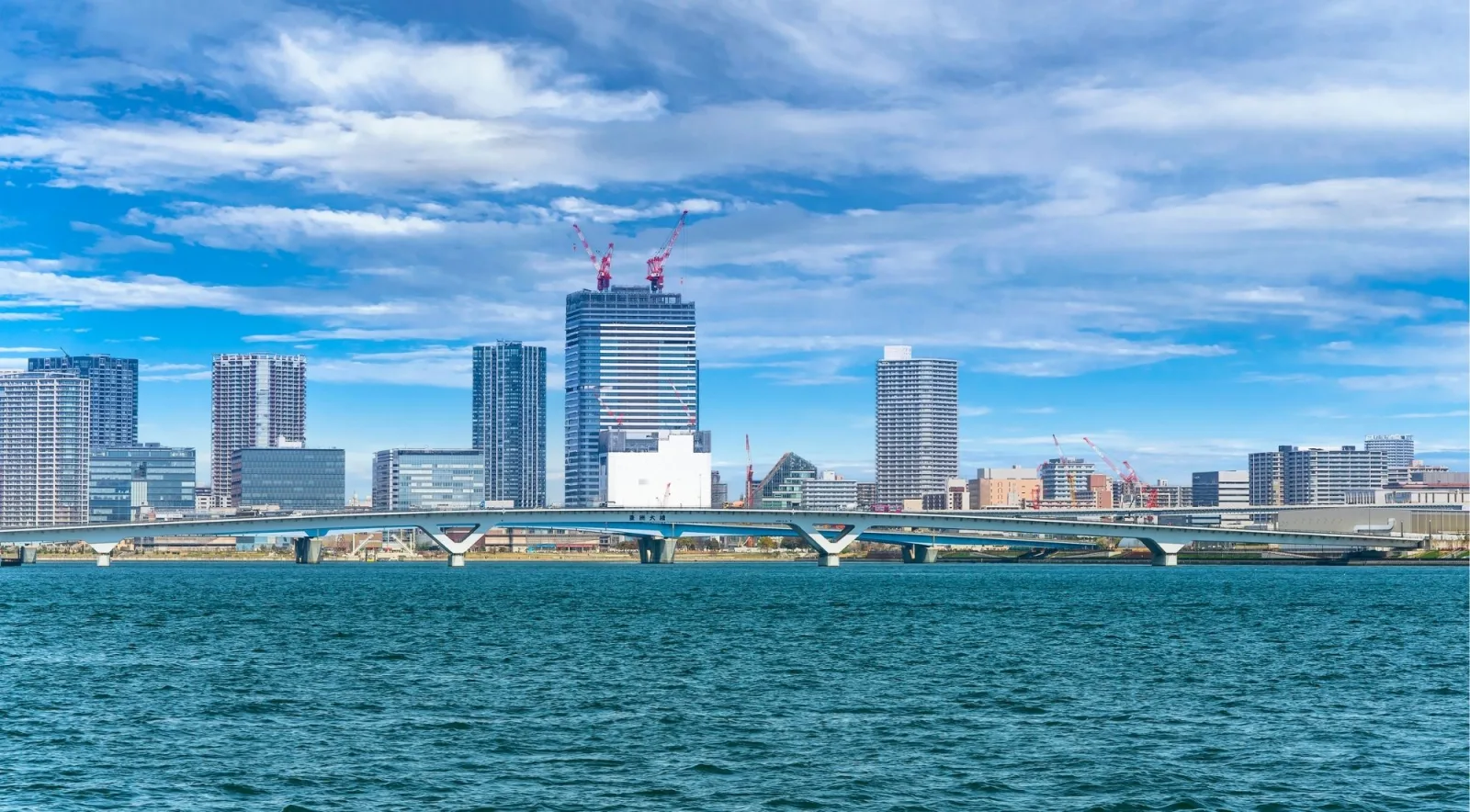
The short answer: Senkyaku Banrai is the Edo-themed food street and 24-hour onsen built beside Toyosu Market to give the sterile new wholesale market the tourist-facing destination it lacked. The food street is free and opens at 10:00am. The onsen never closes — which is why sleeping there is the neatest solution to the pre-dawn tuna auction problem in all of Tokyo.
- It is two buildings, not one. The low Edo-styled Toyosu Edomae Market food street (about 70 shops and restaurants, free to enter) and the tall Tokyo Toyosu Manyo Club hot-spring building (admission charged, open 24 hours, year-round). Both opened on 1 February 2024.
- The onsen-as-hotel trick genuinely works. Sleep in a private room or a reclining lounge chair, then walk about five minutes to the market before dawn. It removes the two real obstacles — trains that start too late and pre-dawn taxi fares — in one move.
- Don’t turn up at 6am expecting the Edo street to be alive. Shops open at 10:00am. Do the market first, then cross over. The single best free thing here is the 8th-floor footbath with its Tokyo Bay view, and it does not require onsen admission.
Everything below is the practical detail: which footbath is free and which is not, what sleeping in a recliner is actually like, the tattoo rule that decides whether the baths are open to you at all, and the honest case against a complex that Japanese media nicknamed the home of the “inbound-don.” If you would rather someone else solved the pre-dawn logistics, the guided market mornings that end here start at the auction:
What Is Toyosu Senkyaku Banrai?
Toyosu Senkyaku Banrai (豊洲 千客万来) opened on 1 February 2024 on the outer edge of Toyosu Market in Koto Ward, Tokyo. The name is a Japanese four-character idiom meaning a constant, unceasing flood of customers — roughly “a thousand guests, ten thousand comings,” or simply “an endless stream of visitors.” It is the auspicious phrase a shopkeeper hangs up wishing for good business, and it sets the tone for the whole place.
The complex was developed and is operated by Manyo Club Co., Ltd. (万葉倶楽部株式会社), a hot-spring hospitality company based in Odawara, Kanagawa, known for its onsen facilities in Yokohama, Hakone and elsewhere. The company’s chairman is Hiroshi Takahashi and its president is Osamu Takahashi.
Why it exists. When the Tsukiji inner market moved to Toyosu in October 2018, the new market was a clean, efficient and — by common agreement — sterile wholesale facility with none of the chaotic outer-market atmosphere that had made Tsukiji a tourist magnet. Senkyaku Banrai was always part of the original relocation plan: a dedicated “attraction facility” (千客万来施設) meant to inherit Tsukiji’s bustle and generate liveliness for the new site. The official concept is “Toyosu Edomae Market” (豊洲江戸前市場) — a place that “sends out Japanese food culture,” continuing the Edomae market tradition.
Getting it built took years. Manyo Club was selected as operator in March 2016, after earlier candidates including the operator of Sushizanmai and Daiwa House withdrew in 2015. The project was then delayed repeatedly — first by the Koike administration’s decision to postpone the market’s move, then by a period when Manyo Club threatened to withdraw entirely after the governor floated redeveloping Tsukiji as a rival “food theme park,” then by Olympic-era construction cost inflation and the pandemic. Construction finally began in October 2021 and the complex opened in February 2024, roughly eight years after Manyo Club was chosen. At its press preview, Manyo Club projected annual visitor numbers of 2.6 million — about 2 million for the commercial building and 600,000 for the onsen, per Nikkei’s report of 30 January 2024.
For the market itself, see our complete Toyosu Market visitor guide and our Tsukiji vs Toyosu comparison.
The Two Main Components
English coverage frequently muddles the structure, so here it is cleanly. Toyosu Senkyaku Banrai is the umbrella name for two connected buildings:
- Toyosu Edomae Market (豊洲場外 江戸前市場) — sometimes rendered “Toyosu Jogai Edomae Ichiba” or “Ichiba-mae Yokocho.” This is the low-rise, three-storey food and shopping building designed to look like an Edo townscape. Free to enter.
- Tokyo Toyosu Manyo Club (東京豊洲 万葉倶楽部) — the tall hot-spring, spa and hotel building, open 24 hours, entered for a fee. This is where the baths, the overnight rooms, the reclining lounges and both footbaths are.
The two are physically adjacent and interconnected; the Manyo Club entrance is on the 2nd floor, next to the food street. A useful mental model: the food street is the ground-level Edo village, and the Manyo Club is the tower rising behind it that contains everything bath-and-sleep related — including the free public footbath on its 8th floor.
The Edomae Market Food Street in Detail
Design and atmosphere
The Edomae Market recreates a lively Edo-period (1603–1868) market town. It was built with traditional materials — granite (mikage-ishi), smoked ibushi roof tiles from Awaji Island, and timber from the Tama region of western Tokyo — so the effect is more considered than a typical themed mall. Wooden storefronts line narrow lanes, and at the centre sits a courtyard with the Toki no Kane (“Bell of Time”), a replica of the Edo-era bells that once told the hour; it chimes through the day. The commercial building covers roughly 14,690 square metres across its three floors.
Floor-by-floor layout
The food building runs from the 1st to the 3rd floor:
- 1st floor: Casual, grab-and-go eateries and ramen shops — the quickest bites.
- 2nd floor: The heart of the complex, home to the two named areas — Mekiki Yokocho (目利き横丁, “Connoisseur Alley”), a narrow lane of fresh and dried goods and standing bars evoking old Tsukiji, and Toyosu Menuki Odori (豊洲目抜き大通り, “Toyosu Main Street”), the lively main promenade of food stalls and famous restaurants. The 2nd floor is also where the pedestrian deck from Shijō-mae Station arrives and where the Manyo Club entrance sits.
- 3rd floor: A mostly indoor food court of sit-down sushi, kaisendon (seafood-bowl), grilled-fish and other restaurants, plus a seafood buffet.
How many shops
Reported figures cluster around 70 shops and restaurants — GO TOKYO and the official site say “about 70”; some English sources say “more than 60.” The majority are food businesses.
What to eat
The range is genuinely wide: Edomae sushi, kaisendon, charcoal-grilled seafood (robatayaki), tuna skewers, tamagoyaki (rolled omelette), seafood burgers, croquettes, wagyu, grilled eel (unagi) and ayu sweetfish, oden, monjayaki, ramen and udon, soba and tempura, poke bowls, plus sweets and crêpes. A local speciality worth seeking out is the Fukagawa croquette, made with clams and sweet potato. Our Japanese fish and seafood field guide names what you’re looking at if the labels defeat you.
Named shops and restaurants — verify on arrival
These are named in the official floor guide and reputable coverage, but tenants change — verify current operation on the day:
- Tsukiji Kagura Sushi (つきぢ神楽寿司) — Edo-style sushi, 2F; a popular Tsukiji name, with a stand-up stall too.
- Marutake Premium (丸武PREMIUM) — tamagoyaki and sweets (custard pudding, castella), 2F; the Toyosu branch of the Tsukiji tamagoyaki specialist.
- Soma Suisan (相馬水産) — tuna specialist known for raw-tuna skewers, 2F.
- Echigoya Sukegoro (越後屋助五郎) — charcoal-grilled fish skewers and onigiri, 2F; very few seats, expect queues.
- Toyosu Kinpura (豊洲 金ぷら) — oden bar, fried kamaboko and craft beer, 2F.
- Edo Fukagawaya (江戸深川屋) — izakaya and Japanese food, 2F.
- Yasuke by Choshimaru (鮨 Yasuke by 銚子丸) — sushi, 2F.
- Tsukishima Monja Jugoya (月島もんじゃ 十五夜) — monjayaki and teppanyaki, 2F.
- Kanaloa — poke bowls, 3F.
- Edo Tsujiya (江戸辻屋) — “Neo-Edomae” sushi and seafood bowls, 3F.
- Maruri Sushi (豊洲 まるり鮨) and Uni Tora (築地海鮮 うに虎) — sushi and kaisendon, 3F.
- Seafood Buffet Iroha (海鮮バイキング いろは) — all-you-can-eat bluefin tuna and snow crab, 3F.
- Toyosu Engimono (豊洲えんぎもの) — souvenirs and Japanese sundries, 2F.
Shopping and souvenirs
Alongside the food there are retail stalls selling dried goods (nori, dried fish), sauces, pickles, premium eggs, knives (Kiwami, a cutlery shop), sweets — Tokyo Milk Cheese Factory trades in the Manyo Club souvenir corner — and general Japanese souvenirs at shops such as Toyosu Engimono.
Opening hours by floor
Hours vary by floor and by shop. Per the official site:
- Retail and shops: 10:00–18:00
- Restaurants, 1F and 2F: 10:00–22:00
- 2F Mekiki Yokocho restaurants: 10:00–18:00
- 3F restaurants: 10:00–20:00. GO TOKYO’s English page has at times listed 3F as 10:00–18:00 — treat the 3F closing time as “evening, verify.”
- Some 2F shops open earlier, at 9:00.
Open on days the market is closed?
Yes — and this is genuinely useful. Toyosu Senkyaku Banrai is open 365 days a year, including Sundays, national holidays and the Wednesdays when Toyosu Market itself is closed. On a market rest day, when the wholesale halls and their restaurants are shut, the Edomae Market and the Manyo Club still operate. One caveat: on those days you cannot enter the market’s own restaurants and shops — but Senkyaku Banrai is a separate facility and stays open. Our Toyosu and Tsukiji opening hours and closed-days guide has the full calendar.
Other Experiences You Might Enjoy
This corner of Tokyo Bay packs an unusual amount into walking distance. The Toyosu Market tuna auction is five minutes from the Senkyaku Banrai deck, teamLab Planets TOKYO is a short walk the other way, and the Yurikamome line carries on past Odaiba, the Rainbow Bridge and Tokyo Big Sight; the Tsukiji Outer Market is about ten minutes away by taxi. Guided Tokyo market mornings are built around exactly that geography — auction, market walk, sushi counter — and most other bay-side experiences start within a few stops:
Tokyo Toyosu Manyo Club — The Onsen in Practical Depth
The building and scale
The bathhouse rises to about nine floors above ground plus a basement, sprawling across roughly 19,095 square metres — much larger than the food building. Reception is on the 7th floor; you enter at 2F and take a lift up. It is a full “super sento” and onsen hotel, with baths, saunas, bedrock bathing, private family baths, relaxation lounges, restaurants, a games corner and kids’ room, massage and beauty services, and overnight rooms.
The hot spring water, trucked from Hakone and Yugawara
The defining feature: real hot-spring water is transported daily by tanker truck from the famous springs of Hakone-Yumoto and Yugawara. You are bathing in genuine meito (celebrated hot-spring) water in the middle of Tokyo — the open-air bath reportedly uses Hakone Yumoto water. It is trucked in (hakobi-yu, “carried water”) rather than piped from an on-site source, which is normal for Tokyo onsen and does not make it any less real natural spring water.
The bathing facilities
The large baths (大浴場) are on the 6th floor, with men’s and women’s sides:
- Indoor baths: large communal baths with big windows, a reclining nemuyu bath, and a high-concentration nano carbonated-spring bath.
- Open-air baths (rotenburo): overlooking Tokyo Bay, and widely praised as among the best urban open-air baths in Tokyo, especially at sunset and after dark.
- Saunas: a dry sauna with an automatic löyly water pour on the hour, and a salt sauna; the women’s side additionally has a mist sauna and a women-only “Nanokura” nano-mist experience bath. Cold plunge pools are provided.
- Private and family baths (kashikiri / kazoku-buro): eight private time-rental bath rooms across the 3rd and 4th floors, each individually named, bookable for a set hourly fee regardless of group size; each has its own toilet and powder area. Reservations are generally same-day only unless you are a premium member.
- Bedrock bathing (ganban-yoku): the “Kokochi-an” (心石庵) area on the 7th floor, with three themed rooms — one women-only, one premium-members-only — using natural mineral stones. It carries a separate fee, and children of elementary-school age and under cannot use it.
Relaxation areas, dining and services
- Reclining lounges. Manyo Club advertises what it calls the largest-scale relaxation room in Japan: 513 TV-equipped reclining chairs across the 2nd, 3rd and 4th floors. The 4th-floor lounge is women-only; the 2nd-floor lounge holds a manga library of about 10,000 volumes. Chairs have TVs, power outlets, USB ports and free blankets.
- Dining. The 5th floor is the main dining floor, with an all-you-can-eat buffet (“Ikoi-dokoro,” roughly 11:30–22:00) and the izakaya-style “Manyo-an” until about 23:00. On the 8th floor, next to the free footbath, sit Cafe Six and a sky dining restaurant that you can use without checking into the onsen.
- Massage and wellness. Thai, Balinese oil, Chinese foot reflexology and other body-care services on the 3rd floor, plus pelvic-stretch and yoga sessions.
- Family facilities. A kids’ playroom, games corner and photo booth on the 7th floor.
Overnight stay options
There are two distinct ways to sleep here.
Private guest rooms. The facility has 57 private guest rooms, on floors 3, 4 and 8 — roughly 71 total rentable rooms once rental rooms and family baths are counted, of which 57 are overnight guest rooms. Types include Western twins (standard and superior), universal accessible twins, Japanese-Western rooms and, on the 8th floor, special view rooms with an in-room Yugawara hot-spring bath (rooms 806 and 807). Room check-in is from 15:00, but you can enter and bathe from 10:00 at no extra charge. In Japanese and Japanese-Western rooms, futon bedding is self-service; all guest rooms are non-smoking. Some English sources say “over 60 guest rooms” — the accurate overnight figure is 57, and the higher number likely counts additional rental rooms and family baths.
The reclining-chair lounges — the budget night stay. You do not need a room to spend the night. With standard admission plus a late-night surcharge you can stay overnight reclining in one of the 513 chairs until 9:00am. There is no capsule-style accommodation; the only non-room overnight option is a reclining chair. The lounge stay is first come, first served and cannot be reserved.
What sleeping in the lounge is actually like. Honestly: it is a very comfortable near-flat reclining chair with a TV, blanket, power and USB — far better than an airport bench — but it is not a bed, the lounge is shared and lit by screens, and there is ambient noise. Light sleepers should expect a nap rather than a full night’s rest. Plenty of travellers use it precisely as an early-checkout or late-flight lounge, or as a cheap overnight base, and rate it good value. If genuinely sleeping well matters to you, book a private room or a nearby hotel — our guide to where to stay for the tuna auction compares every option within walking and taxi distance.
Overnight surcharge and hours
The onsen is open 24 hours, year-round. Standard day admission covers roughly 10:00 to 3:00am. After 3:00am a late-night fee applies, and paying it lets you stay until 9:00am. Beyond 9:00am, hourly extension charges apply — in principle you can stay up to two business days. A separate early-morning asaburo (morning bath) plan exists for arrivals between 5:00am and 9:00am.
Maintenance and cleaning window: the large baths close for cleaning from 3:00am to 5:00am, the changing rooms from 3:30am; the site notes the cleaning end-time was changed to 5:00am from 1 July 2025. Some older blog sources still say 3:00–6:00am, so treat “roughly 3–5am, verify” as the safe assumption. The facility itself stays open through this window; only the big baths pause.
Tattoo policy — important for international visitors
Manyo Club’s official rule: guests with tattoos, tattoo-like stickers or body paint are, in principle, not admitted. However, if a tattoo can be covered by up to two of the facility’s own cover seals, each 11cm × 20cm and sold at the front desk, you may enter — and you must keep it covered throughout your stay, not only in the baths. Tattoos too large to cover with two seals, or a refusal to use the seals, means no entry; undeclared tattoos lead to immediate eviction without refund. In practice, small tattoos are workable with seals, while larger or multiple tattoos effectively bar you from the communal baths. This is decisive for many overseas visitors, so plan accordingly — or book a private family bath.
Reservations
Day bathing needs no reservation. For overnight rooms, book ahead; same-day is possible but rooms may be full. The reclining-lounge overnight stay cannot be reserved — it is walk-in only. Private family baths and rental rooms are same-day booking for non-premium members.
What to bring, what’s provided
Admission includes a yukata (館内着), bath towel and hand towel, and use of the in-house amenities: shampoo, conditioner and body soap, hand soap, lotion, milk, make-up remover, cotton, swabs, hair ties, dryers, body-scrub towels, hairbrushes and hair caps. Effectively you can arrive empty-handed (teburo). Free Wi-Fi runs throughout. Bring your own small towel for the free 8th-floor footbath, where towels are sold rather than given — unlike the members’ rooftop footbath.
Accessibility and family suitability
The complex connects step-free to Shijō-mae Station via the pedestrian deck, with wide gates and tactile paving; multi-purpose accessible toilets are on the 3rd, 5th and 7th floors, and universal accessible twin rooms exist. Note that canes and wheelchairs are not permitted inside the large bathing area itself. It is family-friendly — kids’ room, games corner, family baths, and a nursing room with a diaper table on 7F — but children who are not toilet-trained cannot enter the communal baths; a baby bath is provided, and family baths accept untrained children. Tokyo bylaw means children aged 7 and over, or 120cm and taller, must use the bath matching their own gender. Guests under 18 cannot enter alone.
Pricing
Admission to the food street is free. The Manyo Club charges an admission fee that sits on the higher side for a Tokyo super sento but includes yukata, towels and lounge access. Add-ons — bedrock bathing, family baths, massages, the buffet, the late-night surcharge and hourly extensions — cost extra. Private rooms are a full hotel-tier expense; the reclining-lounge overnight is markedly cheaper than a room and is frequently described as cheaper than a Tokyo business hotel.
All prices change — check the official site before you go. Discounted admission tickets are commonly available online, and registering on LINE at the 7F desk is the standard in-person discount.
The Footbaths — Cleared Up
This is the single most-confused topic in English coverage, so here is the precise distinction. There are two footbaths, both reached via the Manyo Club lifts:
- Senkyaku Banrai Footbath Garden (千客万来足湯庭園) — 8th floor — FREE and open to everyone. You do not need to pay the onsen admission. Anyone can go up to the 8th floor and soak their feet with a Tokyo Bay view. Bring a small towel, or buy one from the vending machine on 8F; they are not free here. Cafe Six and the sky dining restaurant are alongside.
- Scenic Ashiyu Footbath Garden / Tenbo Ashiyu Teien (展望足湯庭園) — rooftop — Manyo Club customers only. This is the 360-degree panoramic rooftop footbath, open only to paying onsen guests, day or overnight. You reach it by checking in at the 7F front desk, going to 9F, then up the stairs to the roof. Towels here are free.
Which view is which. Both have excellent waterfront views. The rooftop one gives the full 360-degree panorama. The 8th-floor free one has a very good Tokyo Bay view including the Rainbow Bridge and a glimpse of Tokyo Tower, but it is not a full wraparound.
Hours — sources conflict, so this stays flagged. Officially listed 9:00–22:00 (GO TOKYO and the official Senkyaku Banrai facility page); the operator’s own opening announcement and local sources say 10:00–20:00. Verify same-day. The members’ rooftop footbath keeps long hours, roughly 6:00am–3:00am, tracking the onsen itself. A real-time crowding monitor by the 2F lifts shows how busy the free footbath is before you make the trip up.
The Rooftop and Views
From the upper floors and the roof you look out across Tokyo Bay: the Rainbow Bridge, the Fuji TV building and Odaiba, the waterfront tower districts of Harumi Flag, and — depending on your exact vantage point and the weather — Tokyo Tower, Tokyo Skytree and Mount Fuji on clear days.
Honest caveat: some reviewers note that from the free 8th-floor footbath, Tokyo Tower and Mount Fuji are only partly visible, obscured by intervening buildings. The unobstructed hero views — the Rainbow Bridge and the bay — are the reliable ones. The rooftop members’ footbath, being higher and fully wraparound, gives the best panorama.
Best times. Late afternoon into evening is the sweet spot: sunset over the bay, then the illuminated Rainbow Bridge and city lights after dark, which reviewers single out as the highlight. For Mount Fuji, come on a clear, dry winter morning. Occasional summer fireworks over the bay are a bonus from either footbath.
The Overnight Strategy for the Tuna Auction
This is the practical heart of the complex. The problem: the tuna auction runs roughly 5:30–6:30am on market days and the market opens to visitors at 5:00am, but the first Yurikamome train from Shimbashi does not reach Shijō-mae until about 6:12am — and even the fastest possible route, via an early Yurakuchō Line service to Toyosu and the first northbound Yurikamome, only reaches Shijō-mae at about 5:17am, which leaves no margin at all. The classic fixes are an expensive pre-dawn taxi or a bed within walking distance. The Manyo Club is the neatest version of “stay nearby,” because it is a few minutes’ walk from the market and never closes.
How the tactic works, step by step
- Evening. Arrive at Manyo Club, enjoy the baths, dinner and the rooftop footbath. Check into a private room from 15:00, or claim a reclining chair in a lounge.
- Overnight. Sleep. Crossing 3:00am automatically incurs the late-night surcharge, which entitles you to stay until 9:00am. The big baths close 3:00–5:00am for cleaning — convenient dead time to be out at the market anyway.
- Pre-dawn, around 4:45–5:00am. Head out. If you have a private room, you keep your key and can come and go freely through the exit gate. If you are a lounge (day) guest, you must first settle your bill at the 7F front desk before temporarily leaving, tell staff you will return, and you keep the same locker; there is no second admission fee on re-entry — but re-entry is only permitted until 9:00am, and surcharges keep accruing while you are out. You can go out in the yukata, and outdoor geta are provided.
- Walk to the market, about five minutes. A short, largely covered walk across the pedestrian deck and past Shijō-mae Station into the market buildings.
- Auction. Watch from the free upper observation walkway, no reservation needed, 5:30–6:30am. The closer lower deck, 5:45–6:25am, requires winning the free monthly online lottery — see our tuna auction viewing and lottery timings guide.
- Breakfast. Eat early sushi at the market’s own restaurants — Sushi Dai, Daiwa Sushi and the rest. Our guide to the best sushi at Toyosu Market covers the queues and which counter suits you.
- Return. Walk back to Manyo Club — before 9:00am if you are a re-entering day guest — bathe again after 5:00am, relax, then check out.
Does it genuinely solve the pre-dawn problem?
Yes. Being already on site removes the two real obstacles: trains that run too late, and costly taxis. You walk to the auction in minutes. The only friction is the day-guest settle-and-re-enter rule and the 9:00am re-entry cutoff.
Versus a hotel or a taxi
- Versus a taxi from central Tokyo. Manyo Club wins on cost if you would otherwise pay repeated pre-dawn fares, and you get the baths as well. A taxi is faster only if you are staying far away and do not want to relocate.
- Versus a nearby hotel. A hotel gives a proper bed and a quiet room, and is also within walking distance — La Vista Tokyo Bay is about a minute from Shijō-mae, Hotel JAL City Tokyo Toyosu about two. Manyo Club wins on the onsen experience and, for the lounge option, on price; a hotel wins on sleep quality. Our hotels near Toyosu and Tsukiji guide works through the trade-off properly.
- Luggage. Lockers at Manyo Club fit about one backpack — fine for a light overnight, not for big suitcases. Store large bags in coin lockers at a hub station, or at your onward hotel, before you come; Shijō-mae Station has coin lockers and Toyosu Station has extensive ones. There is no left-luggage counter for oversized cases at the onsen, though staff hold your belongings via the locker-and-wristband system during your stay.
- Sleep quality. As above: a private room sleeps well; the lounge is a good nap, not a real night.
For the full transport picture, see how to get to Toyosu Market before dawn.
Other Facilities
- Coin lockers and luggage: a locker-and-wristband system inside Manyo Club, about backpack-sized. No oversized left-luggage — use station coin lockers for suitcases.
- Smoking areas: indoor smoking rooms on the 3rd, 5th, 7th and 8th floors of the Manyo Club.
- Payment: cashless-friendly. Major credit cards, transit IC, e-money and QR codes are accepted at the onsen, single-payment credit only. Carry some cash for individual food stalls, as methods vary shop to shop.
- Accessible toilets: multi-purpose accessible toilets on the 3rd, 5th and 7th floors; nursing room with a diaper table on 7F.
- Wi-Fi: free throughout the Manyo Club, and free at Senkyaku Banrai (SSID: SENKYAKU_BANRAI).
- Language: the official website supports four languages, and some in-facility signage carries English, though printed foreign-language pamphlets are limited. English-speaking help is available at the market’s information centre and, per reviews, at the onsen desk.
- Viewpoints: the 8F free footbath deck and the rooftop members’ footbath both double as viewing platforms; the market side has its own rooftop green plaza.
- Parking: a large car park serves the complex, but it is for Manyo Club customers — food-street-only visitors are directed to public transport. Free shuttle buses have run from Monzen-nakacho; a Shimbashi shuttle previously ran but was discontinued from 1 June 2026, so verify current routes.
Getting There
- By Yurikamome: take the line to Shijō-mae Station, about 13–15 minutes from Shimbashi. Senkyaku Banrai connects directly to the station by a pedestrian deck into the 2nd floor — about a four-minute walk. This is the easiest route.
- From Toyosu Market itself: the market buildings and Senkyaku Banrai are effectively neighbours, a three-to-five minute walk along the deck.
- By Tokyo BRT: about a three-minute walk from the Toyosu-shijomae BRT stop.
- By subway: from Toyosu Station on the Yurakuchō Line it is about a ten-minute walk, or a short bus or Yurikamome hop.
- Note: the Yurikamome is not covered by the Japan Rail Pass. First Yurikamome trains run too late for the auction start, which is exactly why the overnight strategy matters.
How It Fits Into a Toyosu Morning
The most common mistake visitors make is arriving at Senkyaku Banrai at 6am expecting the Edo food street to be buzzing. It isn’t. The market’s restaurants open before dawn, but Senkyaku Banrai’s shops don’t open until 10:00am — a few 2F shops from 9:00, the free footbath from 9:00 or 10:00. The natural sequence is:
- Pre-dawn, 5:00–7:00am: tuna auction and early sushi breakfast inside Toyosu Market.
- Mid-morning, from 10:00am: cross to Senkyaku Banrai as its shops open — graze the 2F Edomae stalls for tuna skewers, tamagoyaki and croquettes, and browse the souvenirs.
- Late morning to midday: the free 8F footbath, or a full soak at Manyo Club; lunch at the 3F food court if you are still hungry.
- Afternoon: continue to teamLab Planets, a short walk away, or on to Odaiba.
If you are not doing the auction, Senkyaku Banrai works perfectly well as a standalone late-morning-to-evening outing, and it is open even on days the market is closed. Come on a weekday and after the early rush to avoid the crowds.
Honest Assessment: Is It Worth Visiting?
Verdict: worth a visit as part of a Toyosu morning, or as a relaxing onsen stop — but manage expectations and eat smart.
The criticism is real and worth stating plainly. Senkyaku Banrai is a purpose-built tourist attraction, not an organic market. The writer Kazuki Tanigashira, in Gendai Media, described it as “like an Edo-themed amusement park… a facility overtly aimed at foreign tourists.” Prices are elevated: reviewers report kaisendon at premium prices, and the complex became the poster child for the インバウン丼 (“inbound-don”) meme, with Japanese media reporting eye-watering prices for individual seafood bowls on and shortly after opening day, 1 February 2024 — one report quoted a shop clerk shrugging that customers who think it is a rip-off bowl are welcome to think so. Both Bloomberg, on 20 February 2024, and ITmedia Business, on 26 May 2024, documented the gap between tourists calling the food “reasonable” and locals calling it unaffordable, Bloomberg framing it as the strong pricing reflecting a cheap Japan. Some restaurants are run by operators without deep fish-market pedigree, and the atmosphere, while attractive, is a polished recreation rather than the genuinely chaotic feel of old Tsukiji. Several observers note it draws more Japanese day-trippers than foreign tourists, and that most people feel one visit is enough.
There is a fair case for it, though:
- It answers “what else is there at Toyosu?” — a genuine, pleasant half-day of eating and wandering beside the market.
- The free 8F footbath with bay views is a legitimately lovely, no-cost experience.
- The Manyo Club onsen is excellent — real Hakone and Yugawara water, superb open-air baths, and uniquely useful as a 24-hour base for the auction.
- It is clean, spacious, weatherproof, family-friendly and open on market rest days.
Who it suits: first-time Toyosu visitors wanting the full experience; anyone doing the tuna auction who wants an onsen base; families; travellers with a late flight who need somewhere to relax and nap; onsen lovers.
Who should skip or minimise it: budget travellers chasing the cheapest, most authentic seafood — go to the Tsukiji Outer Market instead; visitors after a real working-market atmosphere; and heavily tattooed travellers, for whom the communal baths are effectively off-limits. For the bigger picture, see our honest assessment of whether Toyosu is worth visiting.
Hours Table
| Facility / area | Location | Hours | Notes |
|---|---|---|---|
| Retail and shops | Edomae Market 1F–3F | 10:00–18:00 | Some 2F shops from 9:00 |
| Restaurants | Edomae Market 1F & 2F | 10:00–22:00 | |
| Mekiki Yokocho restaurants | Edomae Market 2F | 10:00–18:00 | |
| Food-court restaurants | Edomae Market 3F | 10:00–20:00 | GO TOKYO EN has listed 18:00 — verify |
| Tokyo Toyosu Manyo Club (onsen) | Onsen building | 24 hours, year-round | Late-night fee after 3:00am |
| Large baths cleaning closure | Onsen 6F | Closed about 3:00–5:00am | Changed to 5:00am from 1 Jul 2025; some sources say 6:00am |
| Senkyaku Banrai Footbath (FREE) | Onsen 8F | 9:00–22:00 official / 10:00–20:00 local sources — conflict, verify | Free to all; towels sold, not free |
| Scenic Ashiyu Footbath (members) | Onsen rooftop | About 6:00am–3:00am | Onsen customers only; 360° view; free towels |
Frequently Asked Questions
Is Toyosu Senkyaku Banrai free to enter? Yes — the Edomae Market food street is free. The Manyo Club onsen charges admission. The 8th-floor footbath is free even without onsen admission.
What time does it open? Can I go at 6am? No. Shops open at 10:00am, with a few 2F shops from 9:00 and the free footbath from 9:00 or 10:00. The onsen is 24 hours. Don’t arrive pre-dawn expecting the food street to be open — do the market first, then Senkyaku Banrai from 10am.
Is Senkyaku Banrai open when Toyosu Market is closed? Yes, 365 days a year, including Sundays, national holidays and the Wednesdays the market closes.
Can I stay overnight at Senkyaku Banrai to see the tuna auction? Yes. Stay at Manyo Club, in a private room or a reclining lounge, and walk about five minutes to the market before dawn. Day and lounge guests must settle up at the 7F desk before stepping out and re-enter by 9:00am; room guests come and go freely.
Are there private rooms or just lounges? Both — 57 private guest rooms, including Western twins, Japanese-Western rooms and 8F rooms with private onsen baths, plus the reclining-chair lounges. There is no capsule option.
How much does the Manyo Club onsen cost? Prices change. Qualitatively, admission is on the higher side for a Tokyo super sento but includes yukata and towels. Bedrock bathing, family baths, massages, the buffet and the late-night surcharge are extra. Check the official site; discounted tickets are often available online.
Are tattoos allowed at Manyo Club? Not in principle. Small tattoos coverable by up to two 11×20cm seals, sold at the desk, are permitted if kept covered throughout your stay; larger tattoos are not admitted to the communal baths. Consider a private family bath instead.
Do I need reservations? Not for day bathing or the reclining lounge, both walk-in. Recommended for overnight private rooms; same-day for family baths.
What’s the difference between the two footbaths? The free 8F footbath is open to everyone, has a Tokyo Bay view, and you bring or buy a towel. The members-only rooftop footbath is for onsen guests, has the full 360-degree panorama, and towels are free.
Can I see Mount Fuji from Senkyaku Banrai? Sometimes — on clear days from the rooftop. From the free 8F footbath, Fuji and Tokyo Tower are only partly visible past intervening buildings, but the Rainbow Bridge and the bay are reliably in view.
How do I get to Senkyaku Banrai? Yurikamome to Shijō-mae Station, then a four-minute walk across the pedestrian deck into the 2nd floor. The Yurikamome is not covered by the JR Pass.
How to Play It
If you’re doing the tuna auction — the best-value plan. Book a Manyo Club overnight: a private room if you want to sleep properly, or the walk-in reclining lounge if you’re on a budget and just need a base. Arrive in the evening, soak, sleep, then walk to the market before dawn. Lounge guests: settle your bill at the 7F desk before you step out, and be back by 9:00am. Change the plan if you are travelling with large suitcases — there is no oversized storage, so use station lockers — or if you have tattoos too large for two cover seals, in which case book a private family bath or a nearby hotel instead.
If you’re doing a normal daytime visit. Come on a weekday, do the market first thing, then hit Senkyaku Banrai from 10:00am. Graze the 2nd-floor Menuki Odori stalls — tuna skewers, tamagoyaki, Fukagawa croquettes — rather than committing to a pricey sit-down kaisendon. Finish with the free 8th-floor footbath, ideally late afternoon for the sunset-to-night-lights window.
If you mainly want the onsen. Go late afternoon or evening for the open-air bath at sunset and the rooftop 360-degree footbath after dark. Register on LINE at the 7F desk for a discount, and check for discounted admission tickets online before you go.
What would change this advice. If a future first Yurikamome train were timed to reach Shijō-mae before 5:15am, the overnight-base advantage would shrink. If Manyo Club changes its tattoo-cover policy or its 9:00am day-guest re-entry cutoff, re-evaluate the auction plan. If the inbound-don pricing backlash pushes stalls toward more reasonable pricing, the “graze, don’t sit down” advice can relax. Always re-check hours and prices on the official sites — toyosu-senkyakubanrai.jp and tokyo-toyosu.manyo.co.jp — close to your visit.
If you would rather have the pre-dawn logistics, the auction lottery and the best stalls handled for you, Toyosu Tuna Auction & Tsukiji Market Gourmet Adventure (4.90 stars, 415 reviews, from $115) is the broadest match — 3.5 hours, auction plus a tasting walk through the Tsukiji outer market, with a hotel pickup option in selected areas. If the sushi counter is the point, Toyosu Tuna Auction + Breakfast at Sushi Dai or Bentomi (4.63 stars, 153 reviews, from $114) reserves the seat instead. Compare every format in our guide to the best Tokyo fish market tours.
What Might Have Changed Since We Checked
Senkyaku Banrai is a recently opened facility and its details move. These are the specific points worth confirming on the day:
- Free 8F footbath hours conflict between the official listing (9:00–22:00) and respected local sources (10:00–20:00).
- The bath cleaning window is cited as 3:00–5:00am by the official post-July-2025 FAQ, and 3:00–6:00am by older blogs.
- Guest-room count is 57 per booking sites and trip reports; some English sources say “over 60,” likely counting the roughly 71 total rentable spaces.
- 3F restaurant closing time differs between the Japanese official site (20:00) and GO TOKYO’s English page (18:00).
- Named shops turn over — verify each is still trading before you make a special trip for one.
- Shuttle-bus routes change; the Shimbashi service reportedly ended on 1 June 2026.
- All pricing here is qualitative by editorial choice. Fees change constantly — confirm on the official sites.
Book Your Toyosu Tuna Auction Tour
Join 415+ guests who rated this experience 4.9/5. Tuna auction viewing, Tsukiji outer market walk, and fresh sushi breakfast — all with a licensed local guide. Free cancellation.
Check Availability & Book