Toyosu Tuna Auction: Viewing Decks, Lottery & Timings
See Tokyo's Toyosu tuna auction the right way — the free walkway vs. the lottery deck, exact application windows, meeting times, and how to get there before dawn.
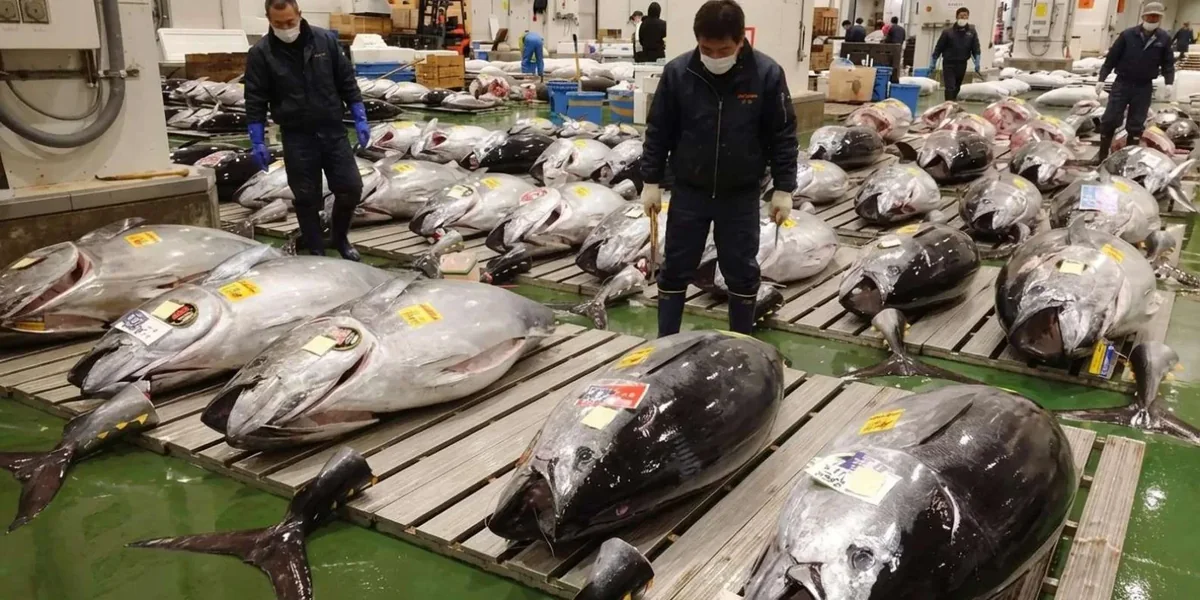
In 2026 you can watch Tokyo’s famous bluefin tuna auction at Toyosu Market two ways — both free. An upper observation walkway needs no booking at all; a closer-up lottery deck requires winning a free advance online lottery, capped at 100 people per day. The single biggest reason travellers fail at either is transport: the earliest any train reaches Shijō-mae is 05:17 — too late for the walkway opening and with essentially no margin for the 5:30am lottery meeting — so you’ll need a taxi or a stay nearby. Everything else — the lottery mechanics, timings, closed days and what to do afterward — follows below.
- Two options, both free: the upper walkway (no booking, opens ~5:00am, sealed glass, distant view) and the close-up lottery deck (win an advance online lottery, 100 spots/day, meet 5:30am, view 5:45–6:25am, you hear and feel the cold of the auction).
- The lottery is the crux: apply at toyosu.jcdlotterysite.jp (English available) in the month before your visit month — the window opens in the first week for about a week, winners are emailed around mid-month, and only winners are notified. One application per group per month, up to five people, up to three preferred dates.
- Getting there beats most people: the earliest any train arrives is 05:17 — via a back-route transfer, not the obvious Shimbashi route — and even that leaves no real margin for the 5:30am lottery meeting. Plan on a taxi or an overnight stay (the 24-hour Tokyo Toyosu Manyo Club onsen is the popular hack). Never go to Tsukiji expecting the auction; it moved to Toyosu in October 2018.
The Two Viewing Options (Read This First)
Almost every mistake at Toyosu comes from not understanding that there are two completely different ways to watch the tuna auction, with different rules.
Option A: The Upper Observation Walkway (free, no booking)
This is the elevated visitors’ gallery — a corridor of large sealed, double-glazed windows on the upper floor of the Fisheries Wholesale Market Building (Block 7), looking down onto the auction floor from above and at a distance.
- Opening time: around 5:00am on market business days. Auction preparation is already well underway by then.
- How early to arrive: get there at 5:00am to claim a spot right at the glass. It fills up — multiple recent first-hand reports describe the corridor already crowded with tourists by 5:00–5:30am, with only a narrow strip of window space.
- What you can see and hear: you look down on rows of tuna, buyers inspecting with flashlights, and the auctioneers at work. Because the glass is fully sealed, you cannot hear the auction directly — audio is piped through speakers, and there is no smell or cold.
- Photography: the sealed glass causes reflections; no flash is permitted. Experienced visitors bring a collapsible rubber lens hood to press against the glass and kill reflections.
- Who it suits: the vast majority of visitors, anyone who couldn’t win the lottery, families, and anyone who values simplicity over proximity.
Option B: The Close-Up Tuna Auction Observation Deck (free, but lottery-only)
This is the on-the-floor deck, on the same level as the auction, separated from the action by a single glass panel that does not reach the ceiling. Because of that gap, sound, smell and the near-freezing cold air come through — it feels like you are part of the scene.
- Booking: free, but you must win an advance online lottery (details below). Only lottery winners are admitted.
- Capacity: 100 people per day.
- Who it suits: photographers and enthusiasts who want the immersive, sensory version and are willing to plan a month ahead and organise pre-dawn transport.
Comparison Table
| Feature | Upper Observation Walkway | Close-Up Lottery Deck |
|---|---|---|
| Booking required | None — just turn up | Win the advance online lottery |
| Cost | Free | Free |
| Location | Upper floor, Block 7 (Fisheries Wholesale Market Building) | Auction-floor level, Block 7 |
| Opens / timing | ~5:00am; view any time until auction ends | Meet 5:30am; viewing 5:45–6:25am |
| Proximity | From above, at a distance | On the same floor, right by the glass |
| Sound | Sealed glass; audio via speakers only | Glass stops short of ceiling — you hear it live |
| Cold | Comfortable (climate-controlled corridor) | Near-freezing auction-hall air comes through |
| Photography | Reflections through glass; no flash | Reflections reduced; no flash; taller visitors can shoot over the panel |
| Best for | Most visitors; families; last-minute plans | Enthusiasts and photographers who plan ahead |
For the full building layout, hours and facilities of Toyosu Market, see our complete Toyosu Market visitor guide.
The Lottery, Step by Step
This is the operational heart of the article. Here is exactly how the official advance lottery (“Advance Raffle Draw for the Tuna Auction Tour”) works in 2026.
Is it operating in 2026?
Yes. The lottery is operating normally in 2026 on a monthly cycle. The official lottery site (toyosu.jcdlotterysite.jp) shows recent completed cycles right through the year, including the September 2026 tour, whose applications closed on 12 August 2026. There is no COVID-era suspension or cap in effect; the pandemic-era reduced capacity has been retired.
Official site and language
- URL:
https://toyosu.jcdlotterysite.jp(English entry point/index_en). The Tokyo Metropolitan Government English site (english.metro.tokyo.lg.jp) and the Tokyo Metropolitan Central Wholesale Market site (shijou.metro.tokyo.lg.jp) both link to it. - Language: the application site and process are available in both English and Japanese. Applications are accepted online only — not by phone or email.
Capacity — 100 per day (and the outdated numbers to ignore)
The current official figure is 100 people per day, confirmed against the Tokyo Metropolitan Government’s own English page: “the total number of people chosen for each day is 100.”
Ignore these outdated/superseded numbers still circulating online:
- 120 per day — the January 2019 launch-era figure, now superseded.
- 27 per day — a temporary COVID-19-era cap, no longer in effect.
- Some blogs describe “3 groups of 40 for 10 minutes each” — treat as an older, unofficial description; the authoritative current figure is 100/day.
Group size, units and age rules
- Up to 5 people per application. Everyone on one application is treated as a single unit — you all win together or lose together, and you all get the same assigned date.
- Age: the representative applicant must be of junior-high-school age or older. Accompanying members can be any age — “from newborn babies to adults” — and age is not factored into the count (every person, including infants, counts toward the 100).
The application window — how the monthly cycle works
Applications open in the month before your intended visit month, for roughly a week in the first half of the month, with winners emailed around the middle of that month. Concrete, verified examples show the recurring pattern:
| Auction (tour) month | Application window | Winners announced |
|---|---|---|
| January 2025 | 4–10 December 2024 | 19 December 2024 (~6:00pm) |
| May 2025 | 2–8 April 2025 | ~mid-April (email) |
| March 2026 | 4–10 February 2026 | 19 February 2026 |
| April 2026 | 4–10 March 2026 | ~19 March 2026 |
| May 2026 | 8–14 April 2026 | ~23 April 2026 |
| June 2026 | 7–13 May 2026 | ~21 May 2026 |
| July 2026 | 3–9 June 2026 | ~18 June 2026 |
| August 2026 | 1–7 July 2026 | ~16 July 2026 |
| September 2026 | 5–12 August 2026 | ~20 August 2026 |
The window typically opens on the first Wednesday of the month at about 3:00pm Japan time and runs about a week to 11:59pm; winners are announced roughly nine to eleven days later, usually on a Thursday around 6:00pm. Always confirm the exact dates for your month on the official site — the pattern is consistent but the precise dates shift.
- Preferred dates: you can list up to three dates you’d accept on a single application; if selected, you’re assigned one of them.
- One application per group per month. You may edit/resubmit, but only your latest application counts, and the same set of people cannot apply again as a separate group. This prevents gaming the draw.
How winners are notified
- Results are sent by email only, to winners only. If you don’t get an email, you can (and should) check your status on the site using the email address and password you registered.
- The winning email cannot be resent, so don’t delete it — take a screenshot/printout. Whitelist
noreply@jcdlotterysite.jpso it isn’t caught by spam filters. - The notification confirms your winning status; on the day you must show the winning results screen (or a copy) plus photo ID.
ID required on the day
Every participant’s identity is checked, including accompanying members, to stop resale/transfer of spots. Bring photo ID (such as a passport) matching the application for each person. If identity can’t be confirmed on the day, you won’t be admitted.
Can you transfer, rename or change dates?
No. You cannot change your assigned date, you cannot transfer or resell the spot, and reselling/scalping is explicitly banned (offenders are removed). If you can no longer attend, the date simply lapses.
Realistic odds of winning
There is no official published application-to-capacity ratio. One travel blog states “only 100 people are selected daily from 5,000 applicants,” but this figure is unsourced and should be treated as an unverified estimate, not fact — no official body publishes application totals.
What credible first-hand reports actually suggest is that the lottery is more winnable than its reputation implies. Multiple travellers report winning — several on their first attempt and even their first-choice date. One experienced guide describes the process as “surprisingly equitable,” noting it is not the seconds-long sell-out seen with other Tokyo hot tickets.
Seasonal variation: it is reasonable to assume demand is higher during cherry-blossom season (late March–April), the New Year period and peak tourist months, which would lower your odds — but no source quantifies this, so treat any seasonal-difficulty claim as informed inference rather than verified data. A practical tip that genuinely helps: if your trip spans two calendar months, you can apply in both months for more chances, and listing all three preferred dates maximises your odds.
If you don’t win
You lose nothing meaningful: anyone who doesn’t win can still watch from the free upper walkway on the same morning. Plan the walkway as your default and treat a lottery win as a bonus. (If you’d rather not gamble on the draw at all, an operator can enter you in it on your behalf when you book by about the 5th of the preceding month — see guided tours below.)
Step-by-step application walkthrough
- Go to
https://toyosu.jcdlotterysite.jpduring the open application window for your target month (check dates first).- Read and agree to the terms/notes, then enter and confirm your email address.
- Open the unique link emailed to you (from
noreply@jcdlotterysite.jp) to reach the form.- Enter the representative’s name, birthday and country of residence (representative must be junior-high age or older).
- Add accompanying members (any age, up to four more — five total), names matching their passports.
- Select up to three preferred dates.
- Submit — one application per group. Note it is not first-come-first-served; timing within the window doesn’t matter.
- After the announcement date, check your email and/or log in to check results. Winners only are notified.
- If you win, screenshot/print the results screen and bring photo ID for everyone on the day.
On-the-Day Logistics for Lottery Winners
- Meeting point: the Promotional Corner / PR Corner, 3rd floor of Block 7 (from the Shijō-mae Station pedestrian deck onto the 3rd floor of the Management Facilities Building, go straight and to the right). Note: the TMG document phrases this as Block 7, 3F; signage on the day directs winners to the PR Corner check-in.
- Meeting deadline: 5:30am sharp. Staff move the group to the deck as soon as everyone gathers, so latecomers miss it — there is no waiting and no refund of your spot.
- Viewing window: approximately 5:45am to 6:25am. Groups are taken in turn to the deck.
- Escorted process / narration: staff escort each group; you follow their instructions. Do not expect a full English narration — the market provides signage/displays (including one explaining the hand signals), but this is an escorted viewing, not a guided commentary. If you want live explanation, that’s what a paid guided tour adds.
- What to wear: the auction hall is refrigerated to near-freezing to preserve the fish, and the deck’s open-topped glass lets that cold air through. Dress in warm layers even in summer — a proper jacket, and closed shoes. This is the single most common comfort mistake.
- Rules on the deck: no flash photography; no touching anything; stay within marked areas and follow staff; no eating/drinking; keep quiet; and note you may not participate if intoxicated. Actions that disturb others or the work will get you removed.
If the Lottery Doesn’t Fit Your Trip: Guided Tours
To be clear about what a tour can and cannot do: no operator can reserve or guarantee you a place on the close-up deck — those 100 daily places are allocated only by the official lottery, and every tour views the auction from the free upper walkway. What a good operator can do is enter you in the official lottery on your behalf, provided you book by around the 5th of the preceding month and give them the participants’ full names. The draw is still random, but the admin is handled and you keep the walkway view either way.
That deadline is the one genuinely time-sensitive thing on this page. If your trip is more than a month out and a close-up deck matters to you, booking before the 5th costs nothing extra and buys you a second entry route into the draw.
Beyond the lottery, the practical case for a guide is the pre-dawn logistics: the market opens before the trains reach it, and the auction is 20 baffling minutes without commentary. The best tours pair a licensed English-speaking guide with a walk through Tsukiji Outer Market and a sushi breakfast at a Toyosu counter like Sushi Dai or Bentomi — so your morning doesn’t depend on winning anything. A few well-reviewed options:
Auction Timings and What Actually Happens
The tuna auction runs, broadly, from about 5:30am to 6:30am on business days, though its length varies with volume — sometimes over in about 20 minutes, sometimes closer to an hour.
The morning sequence:
- Laying out (from ~4:30am): rows of tuna — both frozen and fresh — are arranged on the floor, each tagged. Many buyers are on the floor from around 4:30am.
- Inspection (~4:30–5:30am): licensed buyers walk the rows with flashlights, examining the cross-section of the cut tail (placed on top of each fish) for colour, fat and texture; some pick up the tail and feel it, or take a tiny taste with a hooked tool.
- The bell: a hand-clap and the ringing of a bell signal the start.
- The auction: auctioneers deliver rapid, rhythmic calls while buyers bid using the finger/hand-signal system (yubi-zeri / teyari) indicating price per kilogram. Several auctioneers may work simultaneously, with small groups of buyers moving batch to batch. It moves astonishingly fast — “blink and you miss a fish.”
- Bidding begins around 5:30am and the whole thing typically ends by about 6:30am, sometimes as early as ~5:50am on light-volume days.
- Afterward: market workers mark sold fish and move them on forklifts and turret trucks; even if you miss the main event, you can often see just-sold tuna being moved around the market until about 7:00am. After that, there’s little to see.
Frozen vs fresh tuna: both are sold, and the fish come from around the world, not just Japan. According to the Japan National Tourism Organization (japan.travel), “on average 200 fresh tunas and 1,000 frozen tunas are placed on the auction block each day.” Fresh tends to be auctioned first, with frozen following; they’re handled in the same tuna hall but as distinct lots. Arriving at 5:00am gives you the best chance to catch the inspection and both segments.
The green floor: the tuna auction hall floor is green — deliberately chosen to contrast with the red of the tuna flesh, helping buyers judge quality. By contrast, the general seafood auction hall floor is grey.
Secondary auctions: in the adjacent hall, seafood other than tuna is auctioned, and in the Fruit & Vegetable building (Block 5) there’s a produce auction viewable from a large observation deck, starting around 6:30am — worth a look once the tuna auction wraps.
Which Days the Auction Runs
Auctions run only on market business days. The market is closed:
- Every Sunday
- National holidays
- Most — but not all — Wednesdays (the pattern is irregular, following the Tokyo Central Wholesale Market calendar; some Wednesdays are open)
- An extended New Year period (roughly late December to early January)
The Wednesday closures do not follow a simple every-week rule — some weeks the market trades on Wednesday. Always check the official annual business-day calendar (the Tokyo Metropolitan Government publishes “Toyosu Market business day calendar 2026”) before committing to a date. The lottery only runs on business days, so its available dates automatically reflect the calendar. See our full opening hours and closed-days guide for the complete 2026 calendar.
2026 New Year situation
The market closes for the year-end/New-Year break and the first auction of 2026 (hatsu-uri) was held on Monday, 5 January 2026. If your trip falls in the first days of January, plan to visit from around 5 January onward and check the calendar for the exact reopening date.
The First Auction of the Year (Hatsu-uri)
The hatsu-uri — the first auction of the New Year — is a celebrated tradition in which the top bluefin sells for a spectacular, largely ceremonial “good-luck” price, generating global headlines. The prices reflect prestige, national pride and marketing far more than normal market value.
The 2026 result (verified across CNN, AP, Reuters/CBS, Nippon.com, SeafoodSource and others): a 243 kg bluefin caught off Ōma (Aomori Prefecture) sold for a record ¥510.3 million (about US$3.2 million) — which CNN reported “costs 2.1 million yen ($13,360) per kilogram ($6,060 per pound).” The buyer was Kiyomura Corp., whose president Kiyoshi Kimura — the “Tuna King” — runs the Sushi Zanmai chain. Per the Associated Press (5 January 2026), Kimura “broke the previous record of 334 million yen ($2.1 million) he set in 2019.” The AP added that “Kimura later told reporters he was hoping to pay a bit less for it, but ’the price shot up before you knew it.'”
Historical context for record prices:
- 2012: ¥56.5 million (Kimura) — a record at the time.
- 2013: ¥155.4 million for a 222 kg fish — first time past ¥100 million.
- 2019: ¥333.6 million for a 278 kg fish — first New Year auction at Toyosu.
- 2021: a subdued pandemic year — per Euronews (5 January 2021), “the most expensive fish of the day — a 208-kilogram bluefin, bought by the sushi restaurant Ginza Onodera for 21 million yen (€166,000).”
- 2026: ¥510.3 million (243 kg) — the current record.
Why these numbers bear no relation to what tuna actually costs is explained in our guide to bluefin tuna auction record prices.
Can the public watch the hatsu-uri? In principle yes, on the same walkway/lottery basis — but it is much harder and more chaotic: heavy media presence, big crowds and intense competition for the lottery and walkway spots. Most travellers are better off visiting on an ordinary business day, when you’ll actually see the auction clearly.
Getting There Before Dawn — The Biggest Practical Failure Point
The market’s own station is Shijō-mae Station (市場前駅) on the Yurikamome Line, connected to the market buildings by covered pedestrian walkways straight onto the 3rd floor. It is a small, single-exit station about a five-minute covered walk from the halls.
The first-train problem
The earliest any train reaches Shijō-mae is 05:17 — via the first northbound Yurikamome departing Toyosu at 05:15, reached by transferring from an early Tokyo Metro Yurakuchō Line train (which reaches Toyosu around 05:05–05:09 on weekdays). This applies on both weekdays and weekends. Practically:
- For the 5:30am lottery-deck meeting: arriving Shijō-mae at 05:17 plus the ~5-minute walk to Block 7 puts you at the PR Corner around 05:22–05:25 — technically inside the deadline, but with essentially no margin for error. A single delayed connection and you miss it. We do not recommend relying on the train if you’ve won the lottery — the risk isn’t worth it.
- For the ~5:00am walkway opening: you’ll miss the very start by 17 minutes at best, and by the time you arrive the corridor is already filling. You’ll still catch plenty of auction, but not a front-row window from opening.
The obvious route — the first Yurikamome from Shimbashi, departing 05:45 — reaches Shijō-mae only at 06:12, nearly an hour later than the Toyosu-side back-route and well after the auction is underway. Bottom line: trains are marginal even in the best case, and inadequate via the obvious route. Full timetable detail, taxi apps and the overnight-onsen workaround are in our guide to getting to Toyosu Market.
Taxi — the standard solution
For most auction-goers, a taxi is the reliable answer. Tokyo taxis run 24 hours and are readily available at that hour from central hotel districts. Approximate journey times: Ginza and Shimbashi are very close (roughly 10–20 minutes); Tokyo Station area similar; Shinjuku and Shibuya are longer (allow more time from the western hubs). Tell the driver “Toyosu Shijō” (Toyosu Market) or “Shijō-mae Station” so you’re dropped at the right entrance. (Fares vary; we don’t quote prices — budget for a pre-dawn ride and verify before you go.)
Staying overnight nearby
The most comfortable strategy is to sleep close and walk over:
- Hotels within walking distance of the market exist on Toyosu island and the bay area (verify exact walking distance and early-morning access before booking).
- The popular hack: spend the night at the 24-hour Tokyo Toyosu Manyo Club onsen in the Senkyaku Banrai complex right by the market. It has overnight rooms and relaxation lounges where you can nap, then simply walk over before dawn — no taxi needed. Many travellers rate this as the best-value, lowest-stress way to make the auction.
Night buses and other options
There is a Tokyo BRT bus between Shimbashi and Toyosu and Toei buses to the Shijō-mae-Ekimae stop, but early-morning frequencies are limited and, like the train, generally not early enough for the lottery meeting. There is no reliable dedicated night-bus that solves the pre-dawn problem — taxi or overnight stay remain the dependable choices.
Guided Tours and the Auction
Guided market tours are widely sold (including on GetYourGuide-style platforms), and they solve real problems — but be clear on one honest limitation.
Tours generally CANNOT guarantee the close-up lottery deck. Deck access depends on the official public lottery, which no operator controls. Reputable operators say exactly this: they can assist you in entering the lottery (you typically must book by around the 5th of the preceding month and provide participants’ full names), but selection is random and “100% selection cannot be guaranteed.” Most tours therefore view from the free public walkway — sometimes with personalised audio guides for commentary.
What a good guide genuinely adds:
- Solving the pre-dawn transport problem (hotel pickup or a coordinated meeting time before trains run).
- Explaining the hand signals, grading and the whole spectacle in real time — which transforms an otherwise baffling 20 minutes.
- Navigating the large, confusing site efficiently.
- Securing sushi-breakfast seating afterward and touring the Tsukiji Outer Market.
Typical structures and durations: early-morning Toyosu auction tours (often around 3–3.5 hours); combination Toyosu + Tsukiji Outer Market tours; and versions that include a sushi breakfast. Meeting times are early — commonly 4:20–5:15am, sometimes with hotel pickup.
How far ahead to book: book well in advance, especially in peak/cherry-blossom periods — and, crucially, book before the lottery window for your month (by about the 5th of the preceding month) if you want the operator to enter you in the deck lottery. (Tour prices vary by operator and inclusions — verify before booking.)
Ready to book? Compare current Toyosu tuna-auction and combination tours → (Availability and inclusions vary; check the operator’s lottery-assistance terms before you book.)
Is It Worth It? An Honest Verdict
The case against: the spectacle is brief (often ~20 minutes), viewed through glass, from a distance (on the walkway), and demands a brutally early start with awkward, taxi-dependent transport. If you don’t understand what’s happening, it can feel underwhelming — several honest reviewers say the walkway view alone, without context, is a bit anticlimactic.
The case for: it is a genuine, fast-changing piece of living Japanese food culture — the world’s largest tuna auction, with flashlights, bells, hand signals and half-tonne bluefin changing hands for staggering sums. There is nothing else like it, and combined with a dawn sushi breakfast it makes a uniquely memorable Tokyo morning.
By traveller type:
- First-timers / general sightseers: worth it once, ideally via the free walkway or a guided tour for context. Don’t over-invest in the lottery.
- Photographers / food enthusiasts: chase the lottery deck for the immersive, sound-and-cold experience; it’s the best version.
- Families with young kids / anyone transport-averse: consider skipping the deck; do the walkway, or skip the auction entirely and enjoy Toyosu later in the morning plus Tsukiji Outer Market.
- Light sleepers / short trips: if a pre-dawn start would wreck your day, the auction may not be worth the trade-off — Tsukiji Outer Market delivers the food and atmosphere at a civilised hour. Our honest assessment of whether Toyosu is worth visiting works through who should skip it entirely.
Weigh it against the alternative in our Tsukiji vs Toyosu comparison.
What Else to Do After the Auction
A market morning has a natural sequence once the auction ends (~6:30–7:00am):
- Sushi breakfast at the market’s famous counters — Sushi Dai (3rd floor, Block 6, Fisheries Intermediate Wholesale Market Building) and Daiwa Sushi (1st floor, Block 5) — see our full guide to the market’s sushi counters. Both open early (Daiwa around 5:30am); Sushi Dai’s queue is legendarily long (often hours), while Daiwa moves faster. Arriving straight after the auction gives you a head start on the lines.
- Uogashi Yokocho (Mekiki Yokocho) — the intermediate wholesalers’ shopping street with knives, dried goods, tea and market supplies.
- The rooftop green space for a breather and bay views.
- Senkyaku Banrai — the Edo-themed dining/shopping complex next door; note most shops open around 10:00am and restaurants 10:00am–10:00pm, though the onsen is 24-hour and the rooftop footbath opens at 9:00am.
- teamLab Planets — the immersive digital-art museum a short walk away (near Shin-Toyosu), open roughly 8:00am–10:00pm; book timed tickets ahead as they sell out.
- Tsukiji Outer Market — about 15 minutes away; combine both in one morning (auction at Toyosu, food and browsing at Tsukiji from ~8–9am).
Common Mistakes to Avoid
- Going to Tsukiji expecting the auction. The wholesale auction moved to Toyosu in October 2018. Tsukiji’s Outer Market is still great for food — but the tuna auction is not there.
- Missing the lottery application window. It opens a month ahead for only about a week; miss it and the deck is off the table.
- Assuming a tour guarantees deck access. It does not — the deck is by public lottery only.
- Relying on the first train from Shimbashi. It arrives 06:12 — far too late. Even the fastest possible train (05:17, via the Toyosu back-route) leaves no real margin for a lottery meeting. Taxi or stay over.
- Turning up on a closed Wednesday (or Sunday/holiday). Check the official 2026 business-day calendar first.
- Dressing too lightly. The hall is near-freezing; the lottery deck especially is bitterly cold. Layer up year-round.
- Expecting to get close to the tuna. You watch through glass from marked visitor areas; you cannot enter the working floor or touch anything.
FAQ
Do I need a ticket to see the tuna auction? No — the upper walkway is free and needs no ticket. Only the close-up deck requires winning the free lottery.
How much does it cost? Both viewing options are free. Guided tours and sushi breakfasts cost money (varies — verify before booking).
What time does the tuna auction start and end? Roughly 5:30am to 6:30am, with inspection from around 4:30–5:00am. Length varies (about 20 minutes to an hour).
When does the walkway open? Around 5:00am on business days. Arrive then for a window spot.
How do I apply for the lottery, and when? Online at toyosu.jcdlotterysite.jp during the application window in the month before your visit (first week, ~one week long). Winners are emailed around mid-month; only winners are notified.
How many people can be on one application? Up to five, treated as one unit, with up to three preferred dates.
What are my odds of winning? No official ratio is published. First-hand reports suggest it’s more winnable than its reputation — many win on the first try — but demand is likely higher in cherry-blossom season, New Year and peak months. Apply in two months if your trip spans them, and list all three dates.
Can I change my date or give my spot to someone else? No. Dates can’t be changed and spots can’t be transferred or resold.
What ID do I need on the day? Photo ID (e.g. passport) matching the application, for every person, plus the winning results screen.
Can I get there by train? The earliest possible arrival is 05:17, via a specific back-route (not the obvious Shimbashi train). That’s too late for the 5:00am walkway opening and leaves no margin for a 5:30am lottery meeting. Use a taxi or stay overnight nearby for any certainty.
Is a guided tour worth it? For most people, yes — it solves transport and explains the spectacle — but understand it usually views from the free walkway and can’t guarantee the lottery deck.
Is the auction on every day? No — closed Sundays, holidays, most Wednesdays and the New Year period. Check the official calendar.
When was the 2026 first auction and what did the top tuna sell for? 5 January 2026; a 243 kg Ōma bluefin sold for a record ¥510.3 million (~US$3.2 million) to Kiyomura Corp. (Sushi Zanmai).
Can I watch the record New Year auction in person? In principle yes, but it’s far more crowded and media-heavy; an ordinary business day gives a clearer view.
Book Your Toyosu Tuna Auction Tour
Join 415+ guests who rated this experience 4.9/5. Tuna auction viewing, Tsukiji outer market walk, and fresh sushi breakfast — all with a licensed local guide. Free cancellation.
Check Availability & Book