What to Eat at Toyosu Market in Winter: The Best Seasonal Seafood
Winter is the best season to eat at Toyosu: fatty bluefin, kanburi, flounder, oysters and snow crab. What to order, which counters serve it, prices and cold-morning queue tips.
If you can choose when to eat at Toyosu, choose December to February, and order the tuna. As the sea cools, wild bluefin, winter yellowtail (kanburi), flounder, monkfish liver, cod milt, oysters and snow crab all reach their seasonal peak, and the market’s first auction of 2026 produced an all-time record: ¥510.3 million for a single Oma bluefin. The catch is logistics, not flavor. The market is closed on Sundays, holidays, many Wednesdays and over New Year, the famous counters queue for hours in the dark, and a few winter stars (fugu, monkfish hot pot, whole crab) are easier to find outside the market’s breakfast-and-lunch restaurants than inside them.
The short answer:
- Order: an omakase sushi set (about ¥5,500 to ¥6,600) for tuna, kanburi and flounder; a kaisendon seafood bowl (from about ¥2,500); or the winter-only oyster-fry set (about ¥1,600 to ¥1,800).
- Eat it early: most counters open between about 5:00 and 7:00 and close between about 13:00 and 14:30, sooner if they sell out. Toyosu is a breakfast place, not a dinner place.
- Check the calendar: in 2026 the fish side’s last trading day is Wednesday 30 December and it is closed 31 December to 4 January. Senkyaku Banrai next door is open every day.
If you would rather have someone else handle the 5 a.m. start and the queue, the Toyosu tuna auction and Tsukiji market tour (4.9/5 from more than 450 reviews, from $114) includes the auction, a guide and a seafood breakfast. Tours do not run on market closed days, so check your date below.
What is in season at Toyosu in winter
Prices are indicative ranges from visitor reports and menus (2022 to 2026). Market prices change daily and many counters do not post them, so treat these as guides, not quotes.
| Fish or seafood | Japanese | Peak months | Why winter | How to eat it | Where at Toyosu | Rough price |
|---|---|---|---|---|---|---|
| Pacific bluefin tuna (including Oma) | 本マグロ / 大間まぐろ (hon-maguro) | October to January (Oma fattiest October to December) | Cold water and fat-rich prey build fat for winter | Nigiri (akami, chutoro, otoro), maguro-don | Every sushi counter, including Sushi Dai and Daiwa | Included in a ¥5,500 to ¥6,600 omakase; toro add-ons cost extra |
| Winter yellowtail | 寒ブリ (kanburi) | Late November to February | Fattest before spawning; Toyama and Hokuriku are famous for it | Sashimi, nigiri, buri-shabu, buri daikon, teriyaki | Sushi and teishoku counters (Blocks 6 and 7) | In sets; a teishoku is about ¥1,500 to ¥2,500 |
| Olive flounder | 寒ビラメ (kan-birame) | December to February | Firmer, fattier flesh before spawning | Thin-sliced sashimi, nigiri, engawa (fin muscle) | Omakase sets | In sets |
| Monkfish and monkfish liver | あんこう / あん肝 (anko / ankimo) | December to February | The liver swells with fat | Ankimo with ponzu or as gunkan; anko nabe | Ankimo at some sushi counters; the hot pot is rare in the market | An ankimo piece is roughly ¥500 to ¥1,000 (estimate) |
| Cod milt | 白子 (shirako, “tachi”) | January to mid-February | Matures in the coldest months | Gunkan, ponzu, tempura, in nabe | Seasonal sushi and izakaya-style menus | A supplement on top of a set |
| Pacific oyster | 真牡蠣 (magaki) | December to February (some producers say richest in March and April) | Stores glycogen over winter | Kaki-fry, butter-sauteed, raw (rare at the market) | Tonkatsu Yachiyo (Block 7), Odayasu (Block 6) | A kaki-fry teishoku is about ¥1,600 to ¥1,800 |
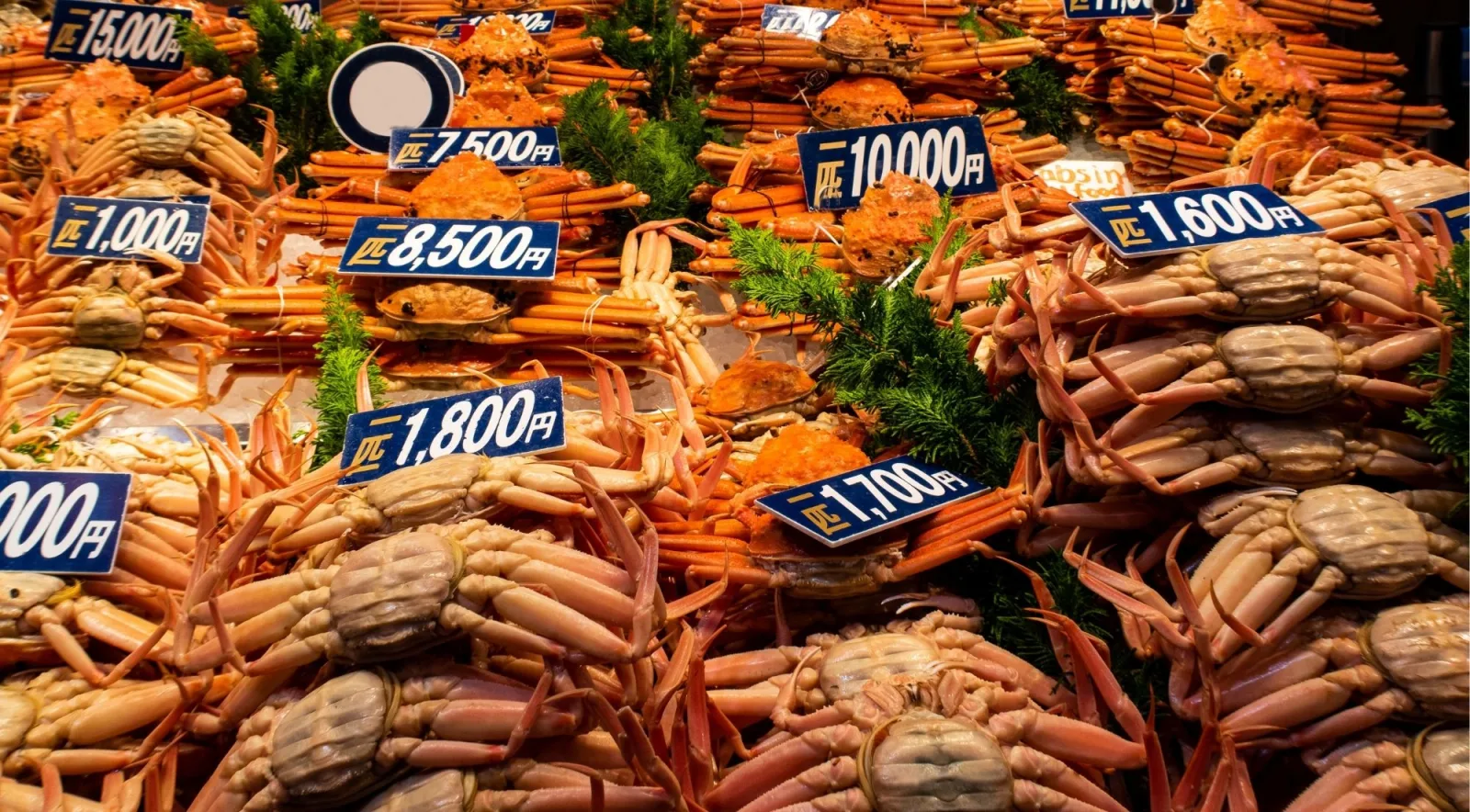
| Snow crab | ズワイガニ / 松葉ガニ / 越前ガニ | 6 November to 20 March (males); females to 31 December; peak December to February | Legal fishing season only | Boiled, kani-miso, sashimi, kani-don | Specialist shops and Senkyaku Banrai; limited in the market | Whole branded crab is often ¥10,000 or more |
| Tiger puffer | 河豚 / とらふぐ (fugu) | November to March | The classic winter delicacy | Tessa (thin sashimi), tecchiri hot pot, shirako | Licensed specialist restaurants; not a Toyosu staple | Courses are often ¥10,000 or more |
| Scallop | 帆立 (hotate) | Winter to spring | The adductor muscle grows sweet | Nigiri, fry, butter-grilled | Sushi sets; Yachiyo’s winter fry set | In sets |
| Golden-eye snapper | 金目鯛 (kinmedai) | December to February | Fattier in cold months | Aburi nigiri, nitsuke (simmered) | Sushi counters, teishoku | A premium piece |
| Spanish mackerel | 寒鰆 (kan-zawara) | December to February | The “kan” prefix marks cold-season fat | Aburi nigiri, saikyo-yaki | Sushi counters | In sets |
| Sea urchin | うに | Mostly summer; Rausu from about January to June | Not a winter peak overall | Gunkan, uni-don | Widely available all year (imported and other grounds) | A supplement (about ¥600 at Sushi Dai, per a 2025 review) |
What “kan” (寒) means. Fish names starting with kan (kanburi, kan-birame, kan-zawara, kan-saba) are a trade convention for fish caught in the coldest months, roughly January and February, and they are generally treated as premium.
Farmed or wild. Farmed bluefin is fatty all year and has no real season. The winter advantage applies to wild fish, so it is worth asking “tennen desu ka?” (天然ですか, is it wild?) at the counter.
Uni is not a winter headline. Most Hokkaido uni peaks from about June to August. A few grounds are winter and spring exceptions, such as Rausu (from about January) and Erimo and Hidaka (about March), so do not go to Toyosu in December expecting the best uni of the year.
If you are planning the whole trip around the season, our guides to the December 2026 opening days and the winter visitor guide for December, January and February cover dates and weather. For the sushi side in more depth, see winter sushi at Toyosu and which fish is in season.
Toyosu sits on Tokyo Bay, close to Senkyaku Banrai and its food street, teamLab Planets, Tsukiji Outer Market, Odaiba and the Rainbow Bridge. Guided Tokyo food tours and other experiences are below:
Where to eat winter seafood at Toyosu
Japan’s tourism board counts 22 restaurants on the third floor of the Fisheries Intermediate Wholesale Market Building (Block 6), about a dozen in the Management Facilities Building (Block 7) and 3 in the Fruits and Vegetables Building (Block 5). Most seafood counters open early and close around lunch, so plan for breakfast.
| Restaurant | Location | Winter angle | Price (latest found) | Notes |
|---|---|---|---|---|
| Sushi Dai (寿司大) | Block 6, 3F | The omakase follows the day’s best fish: winter tuna, buri and hirame, plus one piece of your choice | ¥5,500 omakase (2025 blog reports) | Cash only; queues are often 2 to 5 hours; closed Sundays, Wednesdays and market holidays |
| Daiwa Sushi (大和寿司) | Block 5, 1F | Tuna-forward omakase | ¥6,600 omakase (Tokyo Cheapo) | About 6:00 to 13:00; reports conflict on cash-only and reservations; waits are usually shorter, about 15 minutes to 2 hours |
| Ryu Sushi (龍寿司) | Block 7, 3F | Good-value omakase | About ¥5,500 | Tokyo Cheapo reports cards are accepted; other sources say cash only, so bring yen |
| Sushi Yamazaki (やまざき) | Block 7, 3F | Chirashi loaded with seasonal fish | About ¥3,000 to ¥4,000 | Over 40 years in Tsukiji before the move |
| Sushi Bun (鮨文) | Block 6, 3F | Old-school Edomae sushi; short queues | Mid-range | About 150 years of history |
| Oedo (大江戸) | Block 6, 3F | Kaisendon with winter toppings | From about ¥2,500 | English menu; moderate queues |
| Tonkatsu Yachiyo (とんかつ八千代) | Block 7, 3F | Winter-only oyster, kuruma-ebi and scallop fry set | Kaki-fry teishoku about ¥1,600 to ¥1,800 | About 5:00 to 14:30; cash only; chashu-egg set on Tuesday, Thursday and Saturday |
| Tonkatsu Odayasu (小田保) | Block 6, 3F | The “Kaki Mix” of fried and butter-sauteed oysters, October to May only | About ¥1,800 to ¥2,000 (estimate) | Listed in Tabelog’s Hyakumeiten 2024 |
| Toyosu Senkyaku Banrai (千客万来) | Next to Shijo-mae Station | Grilled tuna skewers, kaisendon, Edomae sushi, eel; open on market holidays | Varies | Opened 1 February 2024; about 70 stores; restaurants roughly 10:00 to 22:00 |
Winter queue strategy:
- At Sushi Dai the queue often starts before 5:00, and you stand outside in temperatures that can be close to freezing at dawn.
- If the auction plus a sushi breakfast is the plan, watch the auction first (about 5:30 to 6:30), then pick a counter with a shorter line: Sushi Bun, Yamazaki, Ryu Sushi or Oedo. A tour that pre-arranges breakfast skips the decision.
- Weekday mornings (Monday, Tuesday, Thursday, Friday) are calmer than Saturdays.
Cash. Bring yen. Sushi Dai and Tonkatsu Yachiyo take cash only, and many other counters prefer it.
Which counter suits you depends on how long you are willing to stand in the cold. Our Sushi Dai and Daiwa guide compares the queues in detail.
The New Year auction and what it means for your plate
Winter is also when Toyosu makes the news. On 5 January 2026 a 243 kg Oma bluefin sold at the first auction of the year for ¥510.3 million, about $3.2 million or ¥2.1 million a kilo, to Kiyomura Corp. (Sushi Zanmai). It broke Kiyomura’s own 2019 record of ¥333.6 million. Recent top bids were ¥114.24 million in 2024 and ¥207 million in 2025.
That price is not a market price. The top tuna is bought for publicity, and the second-best fish that morning sold for a small fraction of it. What you can do is watch the same auction floor from the free second-floor corridor, which opens at 5:00 on trading days, then sit down to an omakase of the same season’s catch an hour later. Our guides to record prices and how to watch the first auction cover the details.
The winter dishes that are hard to find inside the market
Some of the best-known winter foods are not on the in-market breakfast menus:
- Fugu is cooked by licensed specialists and is not a typical Toyosu counter item.
- Anko nabe (monkfish hot pot) and whole crab are specialist dishes. In the market you are more likely to meet ankimo as a piece of sushi or a gunkan.
- Snow crab is in season from 6 November, but whole branded crab is usually sold at specialist shops and restaurants, often from ¥10,000.
Senkyaku Banrai, next to the market, is the most practical fallback. Tokyo’s official GO TOKYO guide says it opened on 1 February 2024 and has about 70 stores, and it is open all year, including market closed days and New Year. Most of it does not open until about 10:00. Our Senkyaku Banrai guide has the layout.
Practical winter logistics
- Hours: visitors can enter from 5:00 to 17:00 on trading days, but most should aim for 5:00 to 11:00. The tuna auction runs about 5:30 to 6:30, and the free second-floor observation windows open at 5:00 with no booking.
- Lower observation deck (closer view, you can hear the bidding):
- Free, by lottery only, for 100 people a day.
- Apply online during a set window in the month before your visit, usually the first week.
- Winners meet staff at about 5:30 and must show ID.
- People who are not selected can still use the second-floor windows.
- Closed days: Sundays, national holidays and designated Wednesdays. In holiday weeks the market closes on Sundays and holidays; in other weeks it closes on Sundays and Wednesdays, with exceptions.
- Extra 2026 closures listed by JNTO include 2, 3, 7, 14, 21, 28 January; 4, 18, 25 February; and 2, 9, 16, 23, 31 December.
- Sunday 27 December 2026 is a special trading day (the visitor walkway is expected to open; confirm in late December), and Wednesday 30 December is a fish trading day (only the produce side closes).
- New Year 2026 to 2027: the last fish trading day is Wednesday 30 December 2026. The market is closed 31 December and the standard 1 to 4 January break, and the first trading day and hatsuseri fall on Tuesday 5 January 2027. Wednesday 6 January 2027 is also open for fish. Both dates come from the official 2027 seafood calendar of the Tokyo Metropolitan Central Wholesale Market.
- Getting there:
- Yurikamome to Shijo-mae (U-14): a covered walkway leads straight into the market.
- First trains: the first train from Shimbashi leaves at 5:45, too late for the start of the auction. From the Toyosu end, trains reach the market at about 5:20.
- Bus: Toei bus 市01 runs from Shimbashi in about 15 to 20 minutes.
- Taxi: ask to be dropped at Shijo-mae Station.
- Hotels: La Vista Tokyo Bay and Hotel JAL City Tokyo Toyosu are steps from the market.
- Parking: there is none for visitors. Our getting there guide covers every route.
- Winter tips:
- Sunrise is late (about 6:50 in early January), so you arrive and queue in darkness.
- Dress in layers: the queues are outdoors and the auction viewing areas are cold.
- On clear winter days the rooftop green plaza on Block 6 can show Mt Fuji. Eating and drinking are not allowed up there.
- Etiquette:
- Stay on the visitor routes; you cannot enter the trading floors.
- No flash in the viewing areas.
- Do not block forklifts and turret trucks.
- Visitors cannot buy wholesale fish, so your seafood comes on a plate.
- Nearby: teamLab Planets is a short walk away, so book a timed ticket for after breakfast (see our half-day itinerary). Tsukiji Outer Market is about 15 minutes away by Yurikamome and the Yurakucho Line, with more street food, and it follows the same Sunday, Wednesday and New Year closure pattern, roughly 30 or 31 December to 4 January.
Dietary and safety notes
- Pregnancy: Japan’s Ministry of Health, Labour and Welfare guidance, as reproduced by Miyagi Prefecture, limits kinmedai, bluefin (kuromaguro) and bigeye (mebachi) to 80 g once a week. It defines 80 g as one sashimi portion or one fillet, and one nigiri topping is about 15 g. The same guidance sets no limit for yellowfin (kihada), albacore and young bluefin. Talk to your doctor about raw fish in general.
- Fugu: Tokyo introduced Japan’s first fugu-preparation licence in 1949. Since 2012, venues without a licensed chef may serve only pre-cleaned “migaki” fugu. Eat it only at established restaurants.
- Allergies: shellfish (ebi, kani) and fish allergies are hard to avoid at counter sushi. Carry a Japanese allergy card.
What a winter breakfast costs
| Budget | What you get | Roughly |
|---|---|---|
| Budget | A fry teishoku, such as the oyster-fry set at Yachiyo | About ¥1,600 |
| Mid-range | A kaisendon at Oedo, or a chirashi set at Yamazaki | About ¥2,500 to ¥4,000 |
| Splurge | An omakase at Sushi Dai, Daiwa or Ryu Sushi, plus toro or uni add-ons | ¥5,500 to ¥6,600, plus extras |
| Guided tour | Auction, guide and breakfast (see below) | From about $114 |
Sushi Dai’s omakase has gone from ¥4,500 to ¥5,500 in a few years, so expect prices to keep rising.
Ordering phrases for the counter
| Japanese | Reading | Meaning |
|---|---|---|
| 旬のおすすめは? | shun no osusume wa? | What is in season? |
| 天然ですか? | tennen desu ka? | Is it wild? |
| 寒ブリ/白子/あん肝をください | kanburi / shirako / ankimo o kudasai | Kanburi, shirako or ankimo, please |
| サビ抜き | sabi-nuki | No wasabi |
| アレルギーがあります | arerugi ga arimasu | I have an allergy |
Guided tours in winter
GetYourGuide lists several Toyosu tours that run on trading days:
| Tour | Length | From | Notes |
|---|---|---|---|
| Toyosu Tuna Auction & Tsukiji Market Gourmet Adventure | 3.5 hours | $114 | 4.9/5 from more than 450 reviews; optional hotel pickup; seafood breakfast |
| Toyosu Tuna Auction + Breakfast at Sushi Dai or Bentomi | About 3 hours | $113 | 4.6/5 from more than 150 reviews; reserved breakfast seat, meal paid at the restaurant |
| Private Toyosu & Tsukiji Market Adventure with Tuna Auction | 3 hours | $165 | 4.8/5 from more than 275 reviews; licensed guide, private group |
Why a tour helps in winter:
- The guide explains the auction hand signals and what the buyers are judging.
- They name the seasonal fish on your plate and say why it is at its best now.
- They solve the 5 a.m. transport gap with a taxi or hotel pickup.
- Some private operators help with the lower-deck lottery application (one asks you to book by the 5th of the previous month). The official lottery FAQ says travel agencies cannot apply for you, so treat that as help with your own application.
No tour can guarantee the lower deck, which is lottery-only. Tours guarantee guided viewing from the public gallery. Our tour comparison and price guide cover the alternatives.
Frequently Asked Questions
What seafood is in season at Toyosu in winter?
Wild bluefin tuna, kanburi (yellowtail), hirame (flounder), ankimo (monkfish liver), cod shirako, magaki oysters, scallops, kinmedai, kan-zawara, snow crab (6 November to 20 March) and fugu (November to March).
Is winter the best time for tuna?
For wild Pacific bluefin, yes. JNTO says Oma tuna season runs from August to January, and Aomori Prefecture’s Amazing AOMORI guide says the fish are at their fattiest from October to December. Farmed tuna has no season.
When is the first tuna auction?
It is held on the market’s first trading day in January. In 2026 that was 5 January; in 2027 it is Tuesday 5 January, per the official seafood calendar.
Is Toyosu open over New Year?
No. The fish market closes from 31 December through about 4 January. Senkyaku Banrai next door is open all year, though individual shops may close.
How much does a sushi breakfast cost?
About ¥5,500 at Sushi Dai, ¥6,600 at Daiwa Sushi and ¥5,500 at Ryu Sushi. Kaisendon starts around ¥2,500 and fry teishoku around ¥1,600.
Can I see the tuna auction without a ticket?
Yes. The second-floor observation windows open at 5:00 with no booking. The closer lower deck is a free lottery for 100 people a day.
Is uni in season in winter?
Mostly no. Peak uni is summer, though Rausu in Hokkaido harvests from about January.
Is it safe to eat fugu?
Yes, at licensed or established restaurants. Tokyo has required licences since 1949.
Can pregnant visitors eat sushi at Toyosu?
Japan’s health ministry guidance limits kinmedai, bluefin and bigeye to 80 g once a week, about one sashimi portion. Choose other fish and consult a doctor about raw fish.
Bottom line
Go on a Tuesday, Thursday or Friday trading day between mid-January and late February, watch the auction from the second-floor corridor at 5:00 and have the omakase afterward. Take the oyster-fry set at Yachiyo or Odayasu if the sushi queue is too long, and keep Senkyaku Banrai for the crab and hot-pot dishes the market counters do not serve. Prices, hours and the 2027 calendar change, so check them before you go. Our complete visitor guide and the guide to when to visit cover the rest.
Book Your Toyosu Tuna Auction Tour
Join 415+ guests who rated this experience 4.9/5. Tuna auction viewing, Tsukiji outer market walk, and fresh sushi breakfast — all with a licensed local guide. Free cancellation.
Check Availability & Book