Winter Sushi at Toyosu Market: What Fish Is in Season (December to February)
Kanburi, bluefin toro, kan-hirame, ankimo, shirako and winter shellfish: the fish in season at Toyosu from December to February, where to order it and what to know about closures.
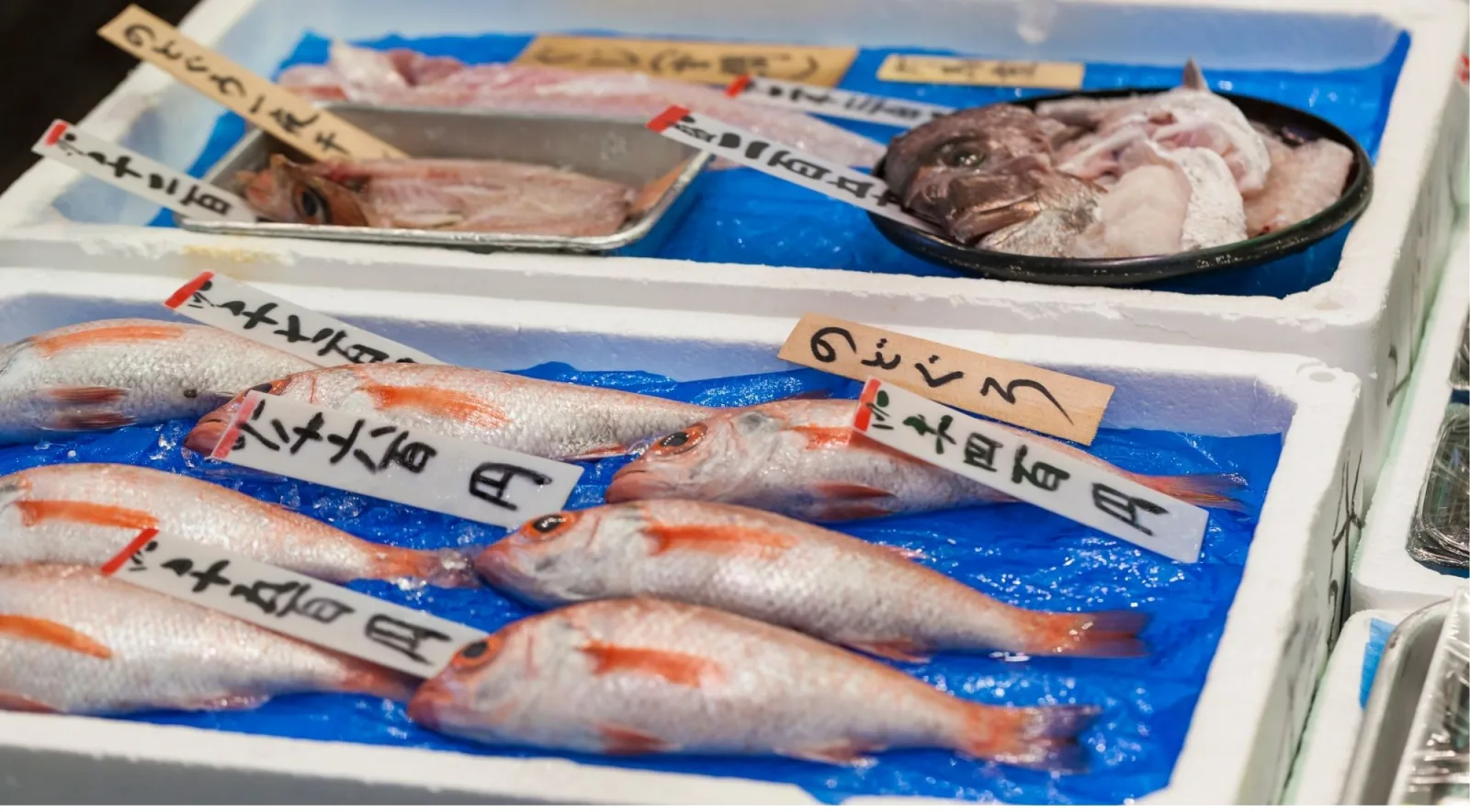
Winter, from December to February, is the best season to eat sushi at Toyosu. Wild yellowtail (kanburi), bluefin toro, flounder (kan-hirame), monkfish liver, cod and fugu milt and the shellfish trio of akagai, tairagai and hokkigai are all at their peak, and the year opens with the New Year tuna auction, where in 2026 one Oma bluefin sold for a record ¥510.3 million. The catch is logistics. The market shuts completely on closed days and over New Year, the close-up auction deck takes no applications over the holidays, and the most famous counters queue for several hours. Plan around those three things and you eat the best fish of the year for about ¥5,500 to ¥6,600 for an omakase set.
The short answer:
- What to eat: kanburi (wild winter yellowtail), hon-maguro chutoro and otoro, kan-hirame with engawa, ankimo, shirako, akagai, tairagai and in-season crab. Peak fat for most of them falls between late December and January.
- Where: Sushi Dai (¥5,500, cash only, queues of hours) and Daiwa Sushi (¥6,600, faster turnover) are the icons. Sushi Bun and Ryu Sushi are the better picks if you want to skip the queue, and Senkyaku Banrai is the fallback on closed days because it opens every day of the year from 10:00.
- When: check the official Tokyo Metropolitan Central Wholesale Market calendar before you book anything. For the last holiday the market was closed 31 December to 4 January, with the first market day and first auction (hatsuseri) on 5 January, and the lottery deck took no applications from 25 December to 5 January.
If you would like a guide and a reserved breakfast seat rather than a four-hour queue, the tuna auction and breakfast at Sushi Dai or Bentomi (4.6/5 from more than 150 reviews, from $113) is the tour built around the sushi counters. Tours run on trading days only, so check your date below.
Winter sushi fish at Toyosu
Prices are indicative tiers for one piece of nigiri at a market-grade counter: ¥ is included in most sets, ¥¥ is a common supplement (roughly ¥500 to ¥1,000 extra), and ¥¥¥ is premium or market price. Counters change prices with the catch, so check before you order.
| Fish (English) | Japanese (kanji / romaji) | Peak months | How it is eaten | Why it is good in winter | Price tier |
|---|---|---|---|---|---|
| Winter yellowtail | 寒鰤 / kanburi | December to February (Himi brand: late November to February) | Nigiri, sashimi, buri-shabu | Wild adults fatten for the southward winter run; flesh is firm and oily | ¥ to ¥¥ |
| Pacific bluefin tuna (toro) | 本鮪 / hon-maguro; 大トロ otoro, 中トロ chutoro | Late November to January (Oma fat peak late November to December) | Nigiri, sashimi | Cold-season fat; otoro is the richest cut | ¥¥ to ¥¥¥ |
| Flounder | 寒平目 / kan-hirame; fin muscle = えんがわ engawa | November to February | Nigiri, thin-sliced sashimi, engawa nigiri | Spawns in summer, so winter fish are thick and sweet | ¥ to ¥¥ |
| Pufferfish | 河豚 / fugu (tora-fugu) | November to February | Tessa (sashimi), tecchiri (hot pot); rarely nigiri | Classic winter delicacy; must be prepared by licensed cooks | ¥¥¥ (specialist restaurants) |
| Fugu milt | 白子 / shirako | December to February, peaking in February | Grilled, in hot pot | Develops before spawning | ¥¥¥ |
| Cod milt | 真鱈白子 / madara shirako (tachi in Hokkaido) | November to February | Gunkan, ponzu appetizer | Creamy and custard-like at its winter peak | ¥¥ |
| Monkfish liver | 鮟肝 / ankimo | December to February | Steamed and sliced with ponzu; gunkan or nigiri | Liver at maximum size, about 40% fat: the “foie gras of the sea” | ¥¥ |
| Ark shell | 赤貝 / akagai | December to March (peak January to February) | Nigiri, sashimi | Plumps up in winter before a summer spawn; red because it carries hemoglobin | ¥¥ |
| Pen shell | 平貝 / tairagai (tairagi) | December to March | Adductor-muscle nigiri, lightly seared | The original “hashira” of Edomae sushi; sweet, crisp bite | ¥¥ |
| Surf clam | 北寄貝 / hokkigai | Winter to early spring | Nigiri (often blanched to turn pink) | Part of the winter shellfish “golden season” | ¥ to ¥¥ |
| Snow crab | ズワイガニ / zuwaigani (Echizen-gani, Matsuba-gani) | 6 November to 20 March (Fukui males) | Boiled, gunkan, nigiri, crab miso | Fished only in the regulated winter season | ¥¥ to ¥¥¥ |
| Female snow crab | セイコガニ / seiko-gani (kobako) | 6 November to 31 December | Whole, with roe | A season of only about 56 days, so a December-only treat | ¥¥ |
| Hokkaido sea urchin | エゾバフンウニ / ezo bafun uni (Rausu) | Rausu season mid-January to end of June | Gunkan, nigiri | Harvested by hand from small boats, sometimes among drift ice | ¥¥¥ |
| Golden-eye snapper | 金目鯛 / kinmedai | December to February (often cited for January) | Nigiri, often skin-seared (aburi) | Oily, soft white flesh in the cold months | ¥¥ |
| Blackthroat seaperch | のどぐろ / nodoguro (akamutsu) | Winter (also autumn) | Aburi nigiri | The “white-fleshed toro”; very high in fat | ¥¥¥ |
| Mackerel | 寒鯖 / kan-saba | Autumn to winter | Shime-saba (cured) nigiri | Fat peaks in cold water | ¥ |
| Spanish mackerel | 寒鰆 / kan-sawara | November to February in Kansai and the Seto Inland Sea (spring in Kanto) | Aburi nigiri | A regional “kan” peak, and a good example of shun varying by region | ¥ to ¥¥ |
| Squid | 甲烏賊 kouika, 槍烏賊 yariika | Winter | Nigiri | Both cited as at their best in winter | ¥ |
| Sweet shrimp | 甘海老 / amaebi (hokkoku akaebi) | Late autumn to winter (Hokuriku) | Nigiri, gunkan | The cold-water Hokuriku catch peaks in winter | ¥ |
| Oyster | 真牡蠣 / magaki | December to February (February often cited) | Raw, gunkan, grilled | A classic cold-month shellfish | ¥¥ |
Not winter fish, despite what some lists say:
- Ikura (salmon roe) is an autumn item, September to November. You will still see it, but it is not winter shun.
- Kohada is a year-round Edomae staple; its famous moment is the summer shinko.
- Aji (horse mackerel) and ishidai are spring and summer fish.
- Botan ebi is more often cited for early spring than deep winter.
- Sayori (halfbeak) is a late-winter-into-spring “first of spring” fish, a good one to look for on an early March visit.
- Hamachi and buri are the same species (Seriola quinqueradiata). Hamachi usually means younger or farmed fish, while kanburi means large, wild winter adults. Sushi University notes that wild winter buri runs about 10% fat, while farmed fish can reach 25 to 30%: more fat, but not necessarily better flavor.
Toyosu sits near Senkyaku Banrai, teamLab Planets, Tsukiji Outer Market, Odaiba and the Rainbow Bridge. Guided Tokyo food tours and other experiences are below:
What shun and kan mean
Shun (旬) is the Japanese idea of an ingredient’s peak moment: not merely when it is available, but the narrow window when fat, texture and flavor line up. Most fish fatten before spawning, so shun often falls in the months just before the spawn.
Kan (寒) means “cold”, and specifically the coldest stretch of the year. Putting kan in front of a fish (kanburi, kan-hirame, kan-saba, kan-sawara) signals that it was caught in deep winter and carries its seasonal fat. A classic saying runs “冬のヒラメ、春のタイ、夏のスズキ”: flounder in winter, sea bream in spring, sea bass in summer.
Why winter fish taste better. In cold water many species lay down fat to survive the cold and to prepare for spawning, and cold water firms the flesh. Toyosu wholesaler Toyosu Shijo.com puts it simply: when sea temperatures drop, fish store fat to protect themselves from the cold.
The season is shifting. Toyosu wholesalers say shun is moving as the seas warm. Yamazaki, president of the Toyosu intermediate wholesaler Yamaji (山治), noted that buri, whose kanji literally contains “師走” (December), has been landed in big hauls off Hokkaido in August, already well fattened, “so the timing is about half a year off.” Taste kanburi in winter while the tradition still holds.
The five fish to order
1. Kanburi (寒鰤, winter yellowtail)
Wild adult buri feed heavily in autumn and are netted as they run south through the cold Sea of Japan, so they are at their fattest in the cold months. The brand to know is Himi kanburi from Toyama Bay, landed from late November to February. To qualify, fish must be caught in Toyama Bay in fixed nets, be auctioned at Himi port and exceed a minimum weight. The Himi fish brand council raised that minimum to 8 kg for the 2025 to 2026 season, up from 7 kg in 2024 to 2025 and 6 kg until 2023 to 2024, according to Hokkoku Shimbun (20 November 2025), and it may change again. Certified fish ship in a blue box with a certificate. Sado Island’s “Sado No.1 Kanburi” label requires at least 15% fat, measured by infrared.
The taste is dense and buttery, almost beef-like, and so fatty that soy sauce beads on the surface. It is usually in the ¥ to ¥¥ tier.
2. Hon-maguro toro (本鮪, bluefin tuna)
Bluefin migrating into the Tsugaru Strait off Oma from autumn to winter are at peak fat. According to the Shungate profile of Oma fishermen, the highest fat content runs from the end of November to around December, and Oma fish are caught one at a time by pole and line (ippon-zuri). The cuts are akami (lean), chutoro (medium-fatty) and otoro (belly). One sushi guide puts otoro at roughly 25 to 30% fat, rising toward 40% at the winter peak, though that is a secondary source and best read as illustrative.
Otoro melts at body temperature, and many chefs judge a fish by its akami instead. Expect the ¥¥ to ¥¥¥ tier. Our guide to otoro, chutoro and akami explains the cuts.
3. Kan-hirame (寒平目, winter flounder) and engawa
Flounder spawns in summer, so by winter the fillets are thick and sweet. It is served as thin-sliced nigiri or sashimi, and engawa, the frill muscle, is a chewy, fatty bonus piece. The taste is clean, delicate and faintly sweet, and flounder is called the “king of white fish”.
4. Ankimo and shirako (the winter creams)
Ankimo is monkfish liver, salted, rinsed with sake, rolled and steamed, then served chilled with ponzu, grated daikon and scallion, or as nigiri or gunkan. Seattle’s Shiro’s puts ankimo fat at about 40%, against 2% for sea bream.
Shirako is milt. Cod milt (tara) is the common sushi-counter version, served as gunkan or with ponzu, while fugu shirako peaks in February and is a specialist fugu-restaurant item. Both are custard-soft, rich and oceanic, and a good dare for adventurous eaters.
5. The winter shellfish trio: akagai, tairagai, hokkigai
Akagai is in season from December to March, peaking in January and February, and summer spawning means winter shells are plump. Miyagi’s Yuriage is the most famous source, and domestic akagai sells for around ¥5,000 a kilo wholesale (much cheap kaiten akagai is imported). Tairagai is the pen-shell adductor, originally what Edomae chefs meant by “hashira”. Winter is the “golden season” for shellfish at the sushi counter.
Crab. Snow crab is a winter star but is more often eaten whole or in crab restaurants than as nigiri. Fukui’s Echizen-gani (male) runs from 6 November to 20 March, the female seiko-gani only from 6 November to 31 December, and the soft-shelled mizu-gani from 19 February to 20 March. Echizen-gani was added to Japan’s Geographical Indication scheme on 27 September 2018.
Uni. Most uni peaks in summer, but Rausu in Shiretoko, Hokkaido, fishes ezo bafun uni from 15 January to 30 June, hand-scooping urchins from small boats. That is the winter uni you will see at Toyosu counters from late January.
Month-by-month: what is peaking
| Month | What is peaking | Visitor notes |
|---|---|---|
| Late November | Oma bluefin fat peak begins; Himi kanburi season opens; snow crab (from 6 November); seiko-gani | A good shoulder month with fewer New Year crowds |
| December | Kanburi, bluefin toro, hirame, ankimo, shirako, seiko-gani (until 31 December) | Year-end rush; the market is closed around 31 December |
| January | Peak buri and toro; kan-hirame; kinmedai; Rausu uni opens mid-January; akagai | Hatsuseri is usually 5 January; the lottery is not open over New Year |
| February | Akagai at its best; fugu shirako; oysters; mizu-gani from 19 February | The quietest month for queues, and the coldest mornings |
| Early March | The last of the shellfish; sayori and spring fish arrive; Echizen crab ends 20 March | Counters offer a mix of winter and spring fish |
For the dates themselves, our guide to Toyosu in winter and the December 2026 opening days list the open and closed days.
Where to eat winter sushi at Toyosu
The market has 39 restaurants across three blocks. The third floor of the Fisheries Intermediate Wholesale Market Building (Block 6) is the main restaurant zone, with about eight sushi shops. Daiwa Sushi is on the first floor of the Fruit and Vegetable Building (Block 5), and Ryu Sushi is on the third floor of the Management Facilities Building (Block 7). Most seafood restaurants open early and close around lunch, and many sell out, so eat breakfast here, not lunch. Restaurants are only open on days the market is open.
| Restaurant | Location | Set or omakase price | Hours (verify) | Payment | Verdict |
|---|---|---|---|---|---|
| Sushi Dai (寿司大) | Block 6, 3F | Omakase ¥5,500 (10 nigiri, 1 piece of your choice, a roll and tamago) | 5:30 to 14:00 (last entry about 13:30) | Cash only | The legend; worth it only if you accept a long wait |
| Daiwa Sushi (大和寿司) | Block 5, 1F | Omakase ¥6,600 (7 nigiri, a roll, tamago and miso soup) | 5:30 to 13:00 | Reports conflict, so bring cash | Our pick for most visitors: quicker turnover and top-grade tuna |
| Sushi Bun (鮨文) | Block 6, 3F | Omakase ¥6,600 (October 2025; it was ¥5,500 in April 2025) | 6:30 to 14:00 | Cash only | Calm and old-school; a good queue-avoider |
| Ryu Sushi (龍寿司) | Block 7, 3F | Omakase about ¥5,500 (Tokyo Cheapo, 2026); lighter sets cost less | 6:30 to 14:00 | Reports conflict, so bring cash | The best value for the wait |
| Oedo Sushi (大江戸) | Block 6, 3F | Kaisendon from about ¥2,500 | Early morning to lunch | Varies | The budget bowl pick |
Sushi Dai. The omakase price climbed from ¥4,500 (2018) to ¥4,800 (2019), ¥5,000 (2022) and ¥5,500 (October 2023). One blogger reported a wait of almost four hours on 5 January 2025, the first market day of the year. A GetYourGuide reviewer on a breakfast tour noted the meal came to about ¥6,000 a person in cash, on top of the tour price. Go if Sushi Dai is the point of your trip. Otherwise the fish at its neighbors comes from the same market.
Daiwa Sushi. The restaurant cooperative says there is little or no wait until about 9:00, and the chefs work fast, so the line moves quickly. Japanese reviewers grumble that prices have risen for tourists (it was ¥4,400 in 2020), and a few call it overpriced, but it remains a benchmark for tuna. Tokyo Cheapo reports it is one of the few market restaurants that accepts reservations, so confirm before you rely on it.
Sushi Bun and Ryu Sushi. Both are traditional Tsukiji-era counters with shorter queues. Tokyo Cheapo’s June 2026 visit says Ryu Sushi accepts credit cards, while the restaurant cooperative page says cash only. Bring yen. Our Sushi Dai and Daiwa guide has more counters.
Budget or splurge:
- Budget (¥2,000 to ¥3,500): kaisendon at Oedo Sushi or lighter sets at Ryu Sushi. Tsukiji Outer Market bowls are typically ¥1,500 to ¥3,000.
- Mid (¥5,500 to ¥6,600): omakase at Sushi Dai, Daiwa, Sushi Bun or Ryu Sushi. This is the sweet spot for winter fish.
- Splurge: add premium winter pieces à la carte (otoro, uni, kanburi belly). Expect “market price” signs and ¥1,000 or more a piece for the top items.
Senkyaku Banrai (豊洲 千客万来)
- What it is: an Edo-themed food and shopping complex next to the market, opened 1 February 2024, with about 70 shops and the 24-hour Tokyo Toyosu Manyo Club onsen.
- Hours: shops 10:00 to 18:00; restaurants 10:00 to 22:00 (some to 20:00, and a few second-floor places from 9:00); the free 8F foot bath garden 9:00 to 22:00; the Manyo Club open 24 hours.
- Why it matters in winter: it opens every day of the year, including market closed days and New Year, which makes it the only Toyosu eating option when the market itself is shut.
- Caveat: prices along the main street skew high, and one 2026 Tripadvisor reviewer balked at an ¥8,000 seafood bowl. The retail zone was renamed Toyosu Jogai Shijo (“Toyosu Outer Market”) on 1 September 2025, so do not confuse it with Tsukiji Outer Market.
- Filling the gap after the auction: the auction ends around 6:25 but Senkyaku Banrai opens at 10:00. The Manyo Club morning bath (reception 5:00 to 9:00, ¥2,200 for adults plus a ¥150 bathing tax) fills that gap; tattoos are in principle not allowed.
Our Senkyaku Banrai guide has the full layout.
Tsukiji Outer Market, for comparison
- Only Tsukiji’s inner wholesale market moved in 2018. The outer market of shops and eateries stayed.
- The recommended visiting window is 9:00 to 14:00; before 9:00 is professional buying time.
- On Sundays and holidays about a third of shops still trade, and over New Year most shops are closed until 4 January.
- It suits grazing, browsing and cheaper kaisendon. Toyosu is better for the auction and the market-counter omakase.
See Toyosu vs Tsukiji for the full comparison.
Practical visitor information for winter
Opening hours and closed days
- Visitor corridor: 5:00 to 17:00 on market days. Closed on Sundays, public holidays and designated closed days (usually, but not always, Wednesdays). According to Sabaku.jp’s 2026 Toyosu calendar, which is based on official Tokyo notices, 45 of the 52 Wednesdays in 2026 were closed days and the other 7 were open.
- PR Corner: 8:30 to 14:30 (Saturdays to 11:30).
- Rooftop green space: 5:00 to 23:00, open even on closed days; on clear winter days you can see Mt Fuji.
- Closed days are total closures: you cannot enter the market, restaurants and shops included.
- December 2026 seafood closed days: 2, 6, 9, 13, 16, 20, 23 and 31 December. Sunday 27 December 2026 is a special trading day, when the visitor walkway is expected to open (confirm in late December), and 30 December is open for seafood. Verify on the official calendar.
- New Year pattern: in 2026 the market was closed 31 December to 4 January and reopened with the first auction on Monday 5 January. The 2027 calendar was published in September 2026, so check it for the exact dates.
Tuna auction viewing
- Second-floor visitor corridor (walk-up): free, no application, no headcount cap, open from 5:00. You look down through glass, and microphones pipe in the auction sound. The auction floor is painted green so buyers can judge the red flesh.
- Tuna Auction Observation Deck (lottery): free, about 100 people a day, maximum five per group. You assemble at 5:30 at the PR Corner on the third floor of the Block 7 Management building, and viewing runs 5:45 to 6:25. Photo ID is required for everyone, and latecomers are sent to the second-floor corridor.
- How to apply: applications open in the first part of the preceding month (around a week) through the official lottery site linked from the Tokyo Metropolitan Government page, and results arrive mid-month. You can list up to three preferred dates, with one application per group. Our lottery and timings guide walks through it.
- The winter catch: applications are not accepted from 25 December to 5 January, and there is no auction on closed days.
- The 5:30 problem: the first Yurikamome from Shimbashi leaves at 5:45, which is too late. The first train from Toyosu leaves at 5:15 and reaches Shijo-mae at 5:17, so otherwise stay nearby or take a taxi.
- Rules: flash photography is banned, intoxicated visitors are refused, and passes cannot be transferred or resold.
Hatsuseri (初セリ), the first auction of the year
- It is held on the first market day in January (5 January in 2025 and 2026), with fresh tuna from just after 5:00.
- 2026: a 243 kg Oma bluefin sold for ¥510.3 million to Kiyomura Corp. (Sushi Zanmai), about ¥2.1 million a kilo. The runner-up fetched only one sixty-fifth of the top price, according to Nippon.com, a sign that the top bid is ceremonial.
- Previous record: ¥333.6 million in 2019, the first New Year auction at Toyosu (a 278 kg Oma fish, also bought by Kimura).
- Recent years: in 2024 a 238 kg Oma bluefin sold for ¥114.24 million to a joint bid by Yamayuki and the operator of Sushi Ginza Onodera. In 2025 a 276 kg Oma fish sold for ¥207 million to the Onodera Group, which Kyodo called “the second highest price on record” and the “fifth consecutive year that the Onodera Group has paid the top price.”
- Sushi Shutatsu’s “Toyosu Tuna Auction Explained” estimates the 2026 fish at about ¥84,000 a piece of sushi, assuming a 50% yield and 20 g pieces. Sushi Zanmai served it at normal menu prices.
Our guides to record prices and watching the first auction go further.
Getting there
- Yurikamome to Shijo-mae (U-14): the station connects to the market by a covered walkway. There is no visitor parking.
- From central Tokyo it is about 27 minutes from Shimbashi.
- There are coin lockers at Shijo-mae station and on the second floor of Senkyaku Banrai.
See also our guide to getting there before dawn.
Weather and what to wear in January
JMA 1991 to 2020 normals for central Tokyo in January: an average high of 9.8°C, an average low of 1.2°C, 59.7 mm of precipitation, 192.6 hours of sunshine and 2.8 snow days. Pre-dawn auction mornings run close to the daily low, and the waterfront feels colder in the wind. Wear a warm coat, hat, gloves and layers, plus comfortable shoes, because the corridors are long.
Etiquette and rules
- Stay inside the visitor corridors. The intermediate wholesale floor is for professionals only, and general consumers cannot buy there.
- No eating or drinking in corridors or on benches (an official rule).
- No flash photography, and watch out for turret trucks.
- At small counters, eat promptly, do not linger after the set, and ask before photographing chefs.
Accessibility
The visitor route uses pedestrian decks and elevators. Senkyaku Banrai lends wheelchairs (limited numbers, request in advance), and some GetYourGuide tours state they are accessible for wheelchair users.
Best days and common mistakes
- Best days: weekday market days (Monday, Tuesday, Thursday, Friday), especially in February. Avoid the first market day of January and Saturdays.
- Common mistakes: turning up on a closed day; assuming “every Wednesday is closed”; taking the first Shimbashi train for a 5:30 meeting; arriving at 10:00 expecting the market to be bustling; bringing no cash; and confusing Toyosu Jogai Shijo with Tsukiji.
- If you land on a closed day: Senkyaku Banrai opens at 10:00, the rooftop garden is open, about a third of Tsukiji’s shops trade on Sundays and teamLab Planets is nearby. Our half-day itinerary puts them together.
- If you do not eat raw fish: tamagoyaki, cooked anago, tempura, tonkatsu and curry shops are in the same buildings.
Guided tours
| Tour | Length | From | What is included |
|---|---|---|---|
| Toyosu Tuna Auction & Tsukiji Market Gourmet Adventure | 3.5 hours | $114 | Auction viewing, seafood breakfast, Tsukiji walk; 4.9/5 from more than 450 reviews |
| Toyosu Tuna Auction + Breakfast at Sushi Dai or Bentomi | About 3 hours | $113 | Auction and a reservation at Sushi Dai or Bentomi; the meal is not included; 4.6/5 from more than 150 reviews |
| Private Toyosu & Tsukiji Market Adventure with Tuna Auction | 3 hours | $165 | Private and customizable; 4.8/5 from more than 275 reviews |
When a tour is worth it:
- Yes, if it is your first visit and you want the auction explained, you want a guaranteed early start and transport, you want a Sushi Dai reservation instead of a four-hour winter queue, or you are in Tokyo over New Year when the lottery is closed.
- Not really, if you are staying in Toyosu or Ariake, you are comfortable with the second-floor corridor and you mainly want to eat.
Tours view the auction from the public walkway, not the lottery deck. Our tour comparison lines the options up.
Frequently Asked Questions
What fish is in season at Toyosu in winter?
Kanburi (wild winter yellowtail), bluefin tuna toro, hirame (flounder), ankimo (monkfish liver), shirako (milt), akagai and tairagai shellfish, snow crab and, from mid-January, Rausu sea urchin.
When is the best time of year to eat sushi in Tokyo?
December to February, when most prized fish carry their highest fat. Late December to January is the peak for buri and toro, and February is best for shellfish and shirako.
Is Toyosu Market open over New Year?
No. In 2026 the market was closed 31 December to 4 January and reopened on 5 January for the first auction. Senkyaku Banrai next door is open every day.
How much did the 2026 New Year tuna sell for?
¥510.3 million for a 243 kg Oma bluefin on 5 January 2026, a record, bought by Sushi Zanmai’s Kiyomura Corp.
Can I see the tuna auction without a lottery win?
Yes. The second-floor visitor corridor is free, needs no application, has no cap and opens at 5:00 on market days.
Can I apply for the tuna auction lottery over Christmas and New Year?
No. Applications are not accepted from 25 December to 5 January.
How much is omakase at Sushi Dai?
¥5,500 (cash only) for 10 nigiri, one piece of your choice, a roll and tamago.
Is kanburi the same as hamachi?
Same species. Hamachi usually means younger or farmed fish, while kanburi means large, wild winter adults.
What should I wear to Toyosu in January?
Warm layers, a hat and gloves: Tokyo’s January average low is 1.2°C and dawn on the waterfront is windy.
Do restaurants at Toyosu take cards?
Many are cash only, including Sushi Dai and Sushi Bun. Bring yen.
Bottom line
Come between late December and February for kanburi, toro and flounder, and in January and February for the shellfish and shirako. Pick a weekday, arrive for the 5:00 corridor, and eat at Daiwa, Sushi Bun or Ryu Sushi unless Sushi Dai is the whole point of the trip. Check the official calendar before you fix a date, because the market is closed over New Year and on most Wednesdays, and keep Senkyaku Banrai in mind as the back-up. Restaurant prices, hours and payment methods change with the season, so confirm them on the day.
Book Your Toyosu Tuna Auction Tour
Join 415+ guests who rated this experience 4.9/5. Tuna auction viewing, Tsukiji outer market walk, and fresh sushi breakfast — all with a licensed local guide. Free cancellation.
Check Availability & Book